
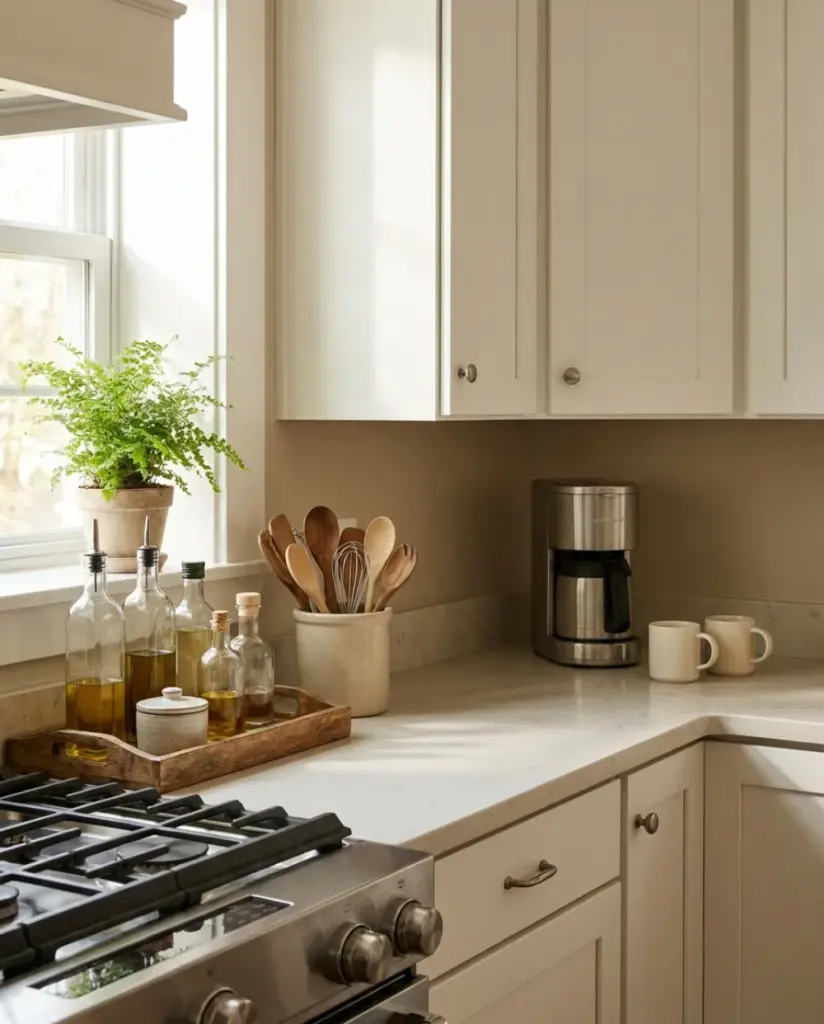
What is the best way to organize kitchen counters?
The best way to organize kitchen counters is to keep only daily-use items out, group them into zones by task, and store everything else in cabinets, drawers or the pantry. A counter works best as a prep surface, not a storage shelf. The method follows six steps:
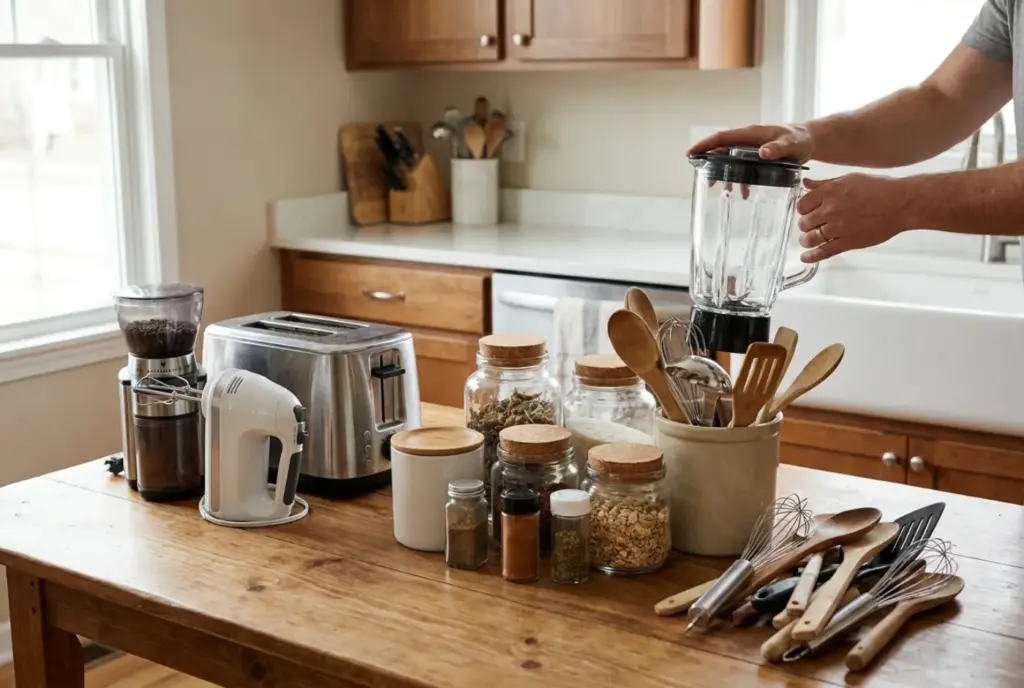
- Clear everything off the kitchen counters.
- Sort kitchen counter items by how often you use them.
- Give each kitchen counter zone one job.
- Corral small items on trays and in canisters.
- Move storage up the wall and into cabinets.
- Reset the counters every night.
Each step takes minutes on its own, and the order matters because sorting before you buy anything prevents wasted purchases. Our kitchen organizing sessions follow the same sequence, starting with a completely bare surface.
1. Clear everything off the kitchen counters
Clearing everything off the kitchen counters is the first step because you cannot judge a space while it is full. Pull every appliance, jar, paper and gadget onto the table so you see the whole inventory at once.
- Unplug appliances and set them on the floor or table.
- Gather loose papers, mail and receipts into one pile to deal with later.
- Move anything that belongs in another room into a basket by the door.
- Wipe the bare counter, backsplash and the wall behind the appliances.
The FDA advises that you wash countertops with soap and hot water along with cutting boards and utensils, so a bare counter is the ideal moment for a deep clean. Once the surface is empty, the real question is what earns its way back.
2. Sort kitchen counter items by how often you use them
Sorting kitchen counter items by how often you use them decides what goes back on the kitchen counter and what moves into storage. Split the pile from the counters into three groups.
- Daily: coffee maker, knife block, cooking oils, salt and pepper, dish soap.
- Weekly: blender, stand mixer, toaster for a once-a-week bagel habit.
- Rarely: slow cooker, waffle iron, bread maker, holiday platters.
Only the daily group goes back on the counter. Weekly items belong in a lower cabinet near an outlet, and rarely used items move to a high shelf or the pantry. Duplicates, broken gadgets and tools nobody reaches for are good candidates for the donation box.
3. Give each kitchen counter zone one job
Giving each kitchen counter zone one job keeps tools beside the task that uses them, so you stop crossing the kitchen for a spatula or a mug. Most kitchen counters divide into four natural zones.
Coffee and breakfast zone
Place the coffee maker near the mugs and the water source. Keep filters, pods and sugar in one small container beside it.
Prep zone
Leave the longest open stretch of counter, ideally between the sink and the stove, completely clear. A cutting board and knife block are the only items that belong here.
Cooking zone
Group oils, salt, pepper and a utensil crock beside the stove. A spice collection that grows beyond a few jars usually works better in a drawer, and our guide on how to organize spices covers the options.
Sink zone
Keep dish soap and a brush in a raised caddy so water drains off and nothing sits in a puddle. Sponges dry faster standing upright than lying flat on the counter.
Zones only work when they match how your household actually cooks. A family that bakes every weekend may trade the coffee zone for a baking zone, and that is the right call.
4. Corral small kitchen counter items on trays and in canisters
Corralling small kitchen counter items on trays and in canisters makes a group of objects read as one tidy unit. A tray also lets you lift everything at once to wipe the counter underneath.
- Use a tray or wooden board for the oils and salt by the stove.
- Stand utensils upright in a single crock instead of filling a drawer.
- Decant flour, sugar or coffee into matching clear canisters if you use them daily.
- Set a small dish by the sink for rings and a sponge.
Buy containers last, after you know exactly what needs a home. Measuring the depth of the counter and the height under the upper cabinets first prevents returns. The same measure-first rule applies when you organize kitchen cabinets and drawers to receive what leaves the counter.
5. Move storage up the wall and into cabinets
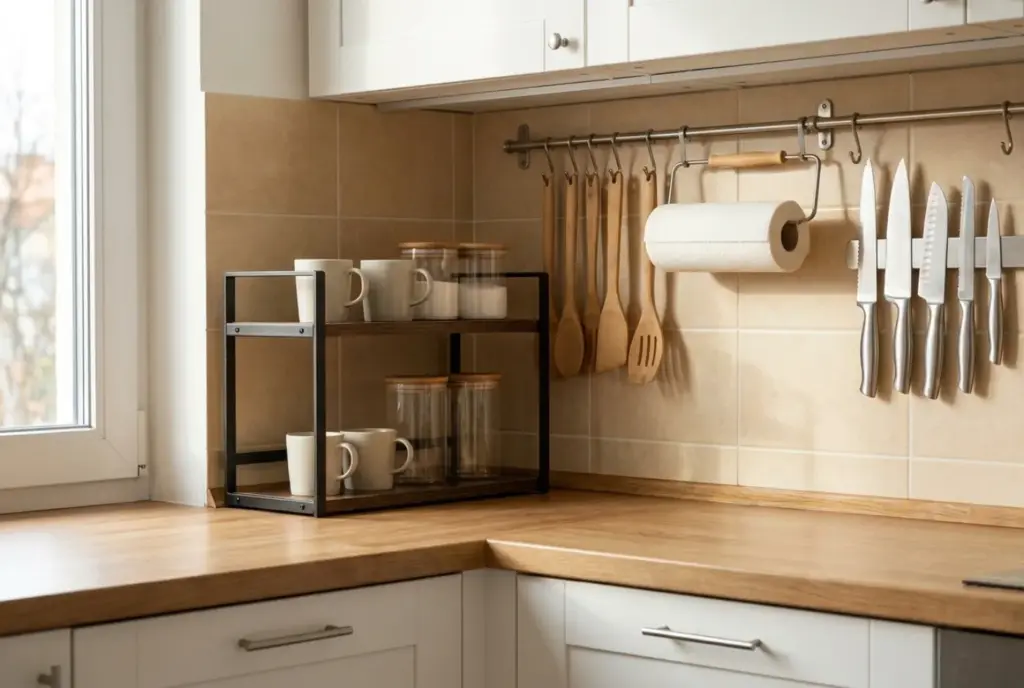
Moving storage up the wall and into cabinets frees counter space without getting rid of things you still use. Vertical storage works especially well in small kitchens.
- A wall rail with hooks holds utensils, mugs or a paper towel roll.
- A two-tier countertop shelf doubles the space in a corner.
- A magnetic strip keeps knives off the counter entirely.
- Pull-out bins inside lower cabinets hold the weekly appliances.
Rarely used appliances often fit on pantry shelves, and our guide on how to organize a pantry shows how to make room for them. Choose adhesive or freestanding options if you rent.
6. Reset the counters every night
Resetting the kitchen counters every night takes about five minutes and keeps the system working. The goal is to return the counter to its organized baseline before bed.
- Return every item to its zone.
- Move mail and school papers to a landing spot in the entryway.
- Wipe the prep zone so it is ready for the morning.
A reset only works when everything already has a home, which is why the earlier steps come first. If the same item lands on the counter every night with nowhere to go, give it a home in a nearby drawer or cabinet instead of fighting it. Shared households do best when everyone knows the reset and where each zone lives.
What should not be kept on kitchen counters?
Perishable food, paper piles and anything flammable near the stove should not be kept on kitchen counters. Keeping these three categories off kitchen counters removes most of the daily mess and a few real safety risks.
- Perishables: the FDA’s two-hour rule says food that needs refrigeration should not sit at room temperature for more than two hours, or one hour above 90°F.
- Paper: mail, permission slips and receipts belong in a wall file or a drop zone by the door.
- Flammables: towels, oven mitts and paper packaging belong away from the burners.
Stove safety is a practical reason to keep that zone open. The U.S. Fire Administration reports that fire departments responded to an estimated 170,000 home cooking fires in 2021, making cooking the leading cause of home fires. A clear counter beside the stove leaves space to set down a hot pan or a lid quickly.
How do you organize kitchen counters in a small kitchen?
Organizing kitchen counters in a small kitchen means keeping one appliance out at most and moving every other daily item up the wall or into a cabinet. Every inch of open counter becomes prep space.
- Choose one appliance to keep out, usually the coffee maker.
- Store the toaster in a cabinet and pull it out when needed.
- Use the inside of cabinet doors for lids and cutting boards.
- Hang a rail under the upper cabinets for utensils.
Small kitchens reward ruthless editing more than clever products. Our guide on how to organize a small kitchen walks through cabinets, drawers and pantry space in the same order.
How do professional organizers approach kitchen counters?
Professional organizers approach kitchen counters as part of the whole kitchen, because counters fill up when cabinets and the pantry have no room left. A counter that stays clear depends on storage behind it that actually fits the household.
- We map how the family cooks, eats and moves through the room.
- We edit cabinets first so counter items have a place to go.
- We research products and send shopping links, and clients buy only what the plan needs.
- We haul away donations at the end of each session.
For families in Alton, Troy and Edwardsville, that work happens in person, and you can see the local details on our professional organizing in Troy, IL page.
Frequently asked questions
How do I decide where to put things in my kitchen?
Put things where you use them first: mugs by the coffee maker, pans and oils near the stove, and dish supplies at the sink. Store daily items between hip and shoulder height and move seasonal or rarely used pieces to high shelves.
Should small appliances stay on the kitchen counter?
Small appliances should stay on the kitchen counter only if you use them every day. A coffee maker usually earns the space, while a stand mixer, slow cooker or air fryer used once a week fits better in a lower cabinet close to an outlet.
Is it okay to store fruit on the kitchen counter?
Whole, uncut fruit such as bananas, apples and citrus can sit in a bowl on the counter. The FDA recommends refrigerating perishable produce such as strawberries, lettuce and mushrooms, and all produce bought pre-cut or packaged, at 40°F or below.
Where should mail go if not on the kitchen counter?
Mail should go to one landing spot near the door you use most, such as a wall file or a small tray on an entry table. Sort it daily into keep, act and recycle so paper never migrates back to the counter.
How much does it cost to have a professional organize a kitchen?
Just Right Organizing packages start at $850, and every inquiry begins with a free phone consultation. Clients buy recommended products themselves from the shopping links Kalli provides, and donation haul-away is included in each session.
Want help setting up your kitchen counters?
Kalli Erwin and the Just Right team set up kitchens that stay workable, from the counters to the cabinets and pantry behind them. We research the products, send you shopping links and haul away donations at the end of each session. Request a free organizing consultation to talk through your kitchen in Alton, Troy or anywhere in the Metro East.
Articles are researched and drafted with AI-assisted tools, illustrated with AI-generated images, and reviewed by Kalli Erwin before publishing.