
How do you organize spices?
To organize spices, empty every jar onto the counter, toss anything stale, group what is left by how you cook, and store each group in one cool, dark spot where every label faces you. That routine works whether your spices live in a drawer, an upper cabinet, or a pantry door rack. A focused session takes about an hour for a typical collection of 30 to 50 jars.
The six steps below follow the same order our team uses during kitchen organizing sessions:
- Pull out all your spices and check expiration dates.
- Sort spices into groups that match how you cook.
- Store spices in a cool, dark spot away from the stove.
- Choose spice containers and racks that keep labels visible.
- Label and date every spice jar.
- Keep spices organized with a refill routine.
1. Pull out all your spices and check expiration dates
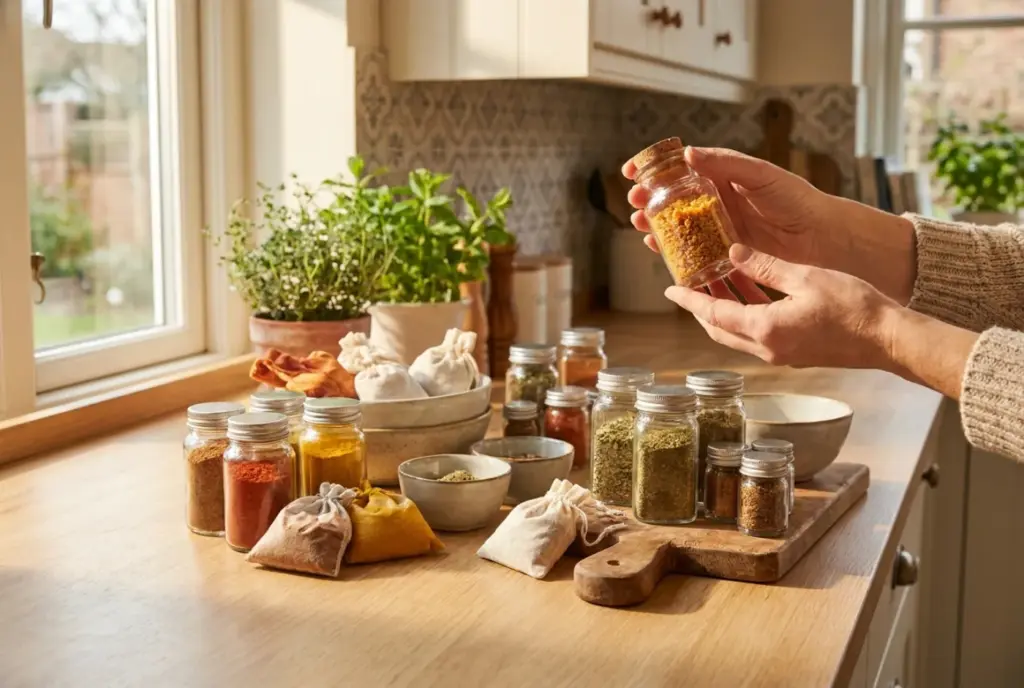
Pulling out all your spices at once and checking expiration dates is the only way to see duplicates, half-empty bags, and spice jars that lost their flavor years ago. Gather jars from the cabinet, the drawer by the stove, the pantry, and the baking bin so the whole collection sits in one place.
The Ohio State University Extension pantry storage guide puts the shelf life of whole spices at 2 years and ground spices and dried herbs at 1 year. Spices rarely turn unsafe, but they fade, and a printed best-by date is a guide to peak quality rather than a hard cutoff. Use these quick checks on every jar:
- Smell test: rub a pinch between your fingers. A faint aroma means the flavor is gone.
- Color check: paprika, chili powder, and dried herbs dull from red or green to brown as they age.
- Clumps or moisture: toss any jar with hard lumps, mold, or a damp smell.
- Duplicates: combine two open jars of the same spice into one, oldest on top.
With the stale jars gone, the collection that remains is usually smaller and far easier to group.
2. Sort spices into groups that match how you cook
Sorting spices into cooking groups works better than a strict A to Z order for most home cooks, because you reach for related flavors together. Keep the groups broad so they stay easy to maintain:
- Everyday basics: salt, black pepper, garlic powder, onion powder, paprika.
- Baking: cinnamon, nutmeg, ginger, cloves, vanilla, cream of tartar.
- Dried herbs: oregano, basil, thyme, rosemary, bay leaves, parsley.
- Heat: chili powder, cayenne, red pepper flakes, chipotle.
- Cuisine sets: taco seasoning, curry powder, garam masala, Italian blends.
Give each group its own row, bin, or section of the drawer so a jar always goes back to the same home. Inside each group, alphabetize only if your collection tops about 40 jars. Smaller collections stay findable by group alone, and the most-used jars should sit at the front or at eye level.
3. Store spices in a cool, dark spot away from the stove
Store spices in one cool, dark drawer or cabinet within a step of your prep area, but away from the stove, because heat is what fades spices fastest. Penn State Extension advises storing dried herbs in airtight containers in a cool, dry, dark area and not near the stove, sink, or windowsill. Steam, oven heat, and sunlight all shorten flavor.
Spice drawer
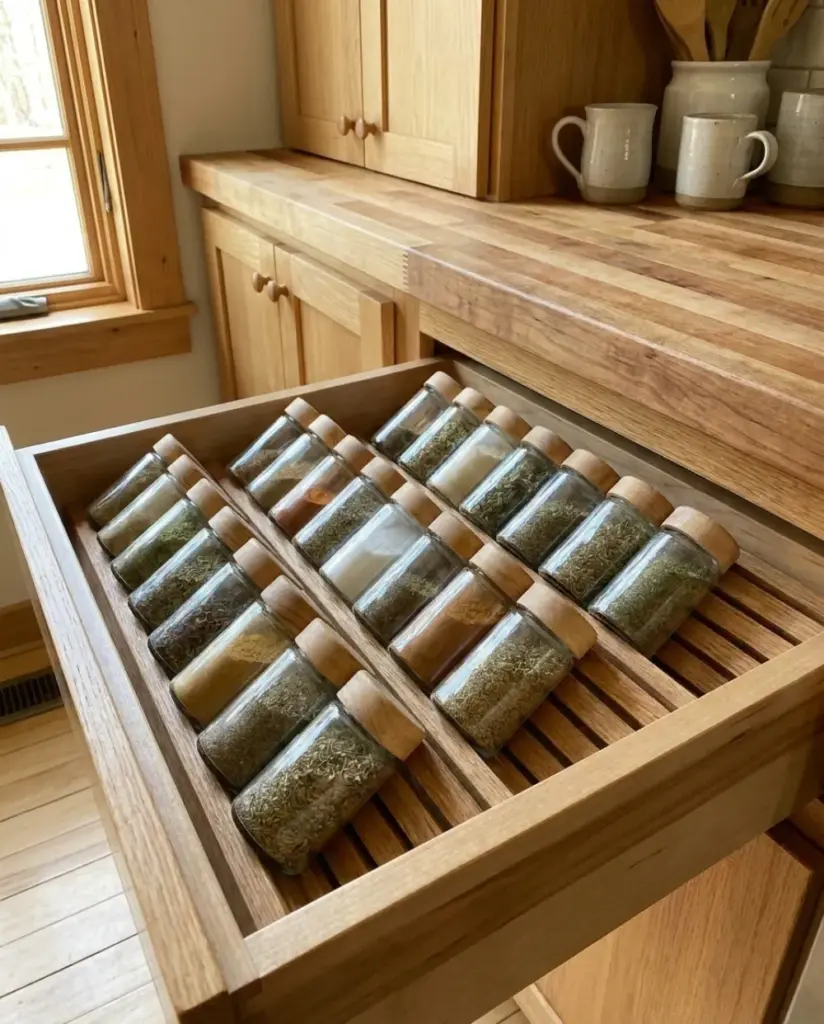
A drawer near the counter lets you read every lid at a glance. It suits uniform jars laid flat or on a tilted insert.
Upper cabinet
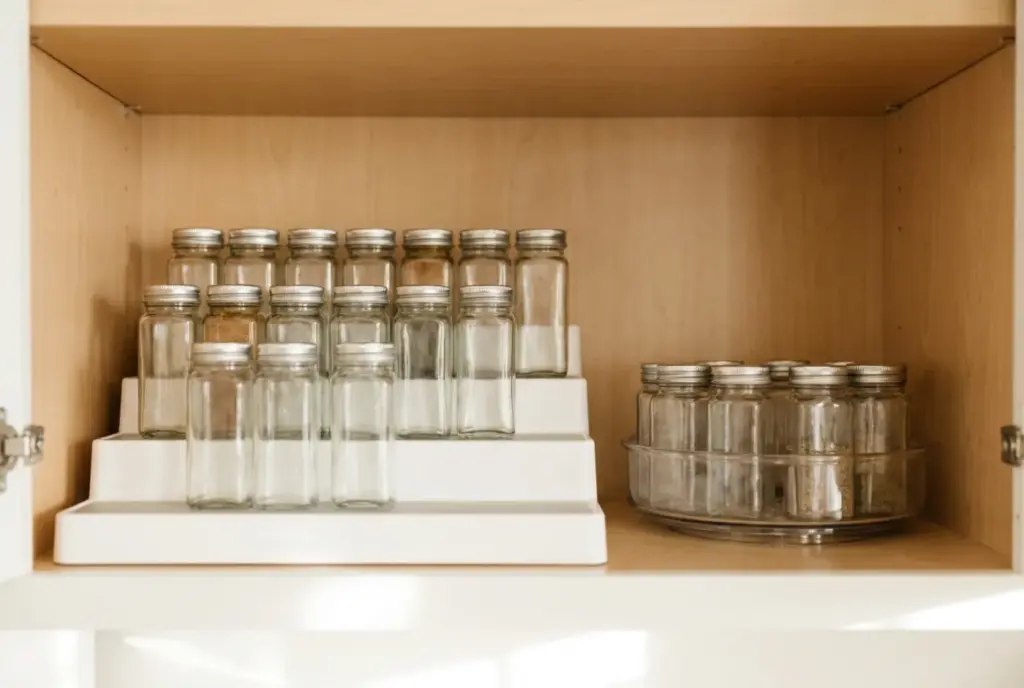
A cabinet works well with tiered risers or a turntable so back-row jars do not disappear. Our guide to organizing kitchen cabinets and drawers covers shelf depth and zoning.
Pantry door or wall rack
A door rack frees shelf space and keeps every jar in one row. It fits well in a pantry you have already organized by food type.
4. Choose spice containers and racks that keep labels visible
The right spice containers and racks are the ones that keep every label visible without moving another jar. You can keep original jars or decant into matching ones; both work when the storage piece fits the space.
- Tiered risers: three-step shelves for cabinets, so every row is visible.
- Turntables: spin-style trays for deep corner cabinets.
- Drawer inserts: angled trays that hold jars on their sides.
- Uniform jars: glass jars with tight lids for a matched look and better seals.
- Clear bins: small bins for packets, bags, and bulk backups.
Glass holds aroma well and does not absorb odors, while plastic is lighter and safer around kids. Measure drawer depth and shelf height before buying anything, since a riser that is half an inch too tall wastes the whole shelf.
5. Label and date every spice jar
Labeling and dating every spice jar keeps your spice system working long after the first week. Penn State Extension recommends labeling dried herb containers with the name and the date, and the same habit works for store-bought spices.
- Put labels on lids for drawers and on the front for cabinets and racks.
- Write the month and year you opened or decanted each spice.
- Use the same label style across the whole collection.
- Cut and tape the original directions inside the lid of blends you love.
Dates also make the yearly review fast, because the oldest jars announce themselves.
6. Keep spices organized with a refill routine
Spices stay organized when a refill routine and a yearly review happen on a schedule instead of in the middle of a recipe. Two small habits cover most of it:
- One overflow bin: keep bulk bags and backups in a single labeled bin in the pantry, not mixed into the daily spot.
- A yearly check: once a year, pull the jars, run the smell test, and let go of anything past its prime.
- A running list: note a spice on the grocery list the moment a jar runs low.
Keep the overflow bin near the main spice spot so refills take seconds, and check it before buying more of anything. Those habits matter most when space is tight, which is where many Metro East kitchens start.
How do you organize spices in a small kitchen?
To organize spices in a small kitchen, keep only the jars you use monthly within reach and move everything else to one backup bin. Vertical space does the rest of the work.
- Mount a slim rack inside a cabinet door.
- Use a two-tier turntable in one corner instead of a full cabinet.
- Choose small jars and buy spices in smaller amounts.
- Store baking spices with baking supplies, not in prime cooking space.
Our guide on how to organize a small kitchen applies the same thinking to the rest of the room, and the fridge follows similar zones in how to organize a fridge.
When does a professional organizer help with spices and pantries?
A professional organizer helps most when spices are one piece of a larger kitchen and pantry reset. Kalli Erwin and the Just Right Organizing team implement functional systems in homes across Alton, Troy, Edwardsville, and the Illinois Metro East.
- We sort, group, and place your spices during kitchen and pantry sessions.
- Kalli researches containers and shares shopping links, and you buy the products you want.
- Donation haul-away is included each session for items you choose to let go.
If you are weighing whether outside help makes sense, our piece on whether hiring a professional organizer is worth it walks through the decision.
Frequently asked questions
How long do spices last?
Whole spices last about 2 years and ground spices and dried herbs about 1 year, according to Ohio State University Extension. Older spices are usually safe but weaker, so smell them before cooking.
Is it better to store spices in glass or plastic containers?
Glass is better for most spices because it seals tightly and does not absorb odors. Plastic works for kids' reach zones or backups, as long as lids close firmly.
Should spices be stored above the stove?
No, spices should not be stored above or beside the stove. Heat and steam from cooking fade flavor faster, so choose a cool, dark drawer or cabinet a step away.
Should you organize spices alphabetically?
Alphabetical order works best for collections over about 40 jars. Smaller collections are easier to use when grouped by cooking type, such as baking, herbs, and heat.
How do you organize too many spices?
Start by checking dates and combining duplicates, then keep only weekly spices in the main spot. Move specialty jars and bulk refills into one labeled backup bin.
Want a kitchen that stays this organized?
Spices are often the first small win in a bigger kitchen reset. If you would like hands-on help sorting your spices, pantry, and cabinets, request a free organizing consultation and we will talk through your space by phone. Packages start at $850.
Articles are researched and drafted with AI-assisted tools, illustrated with AI-generated images, and reviewed by Kalli Erwin before publishing.