
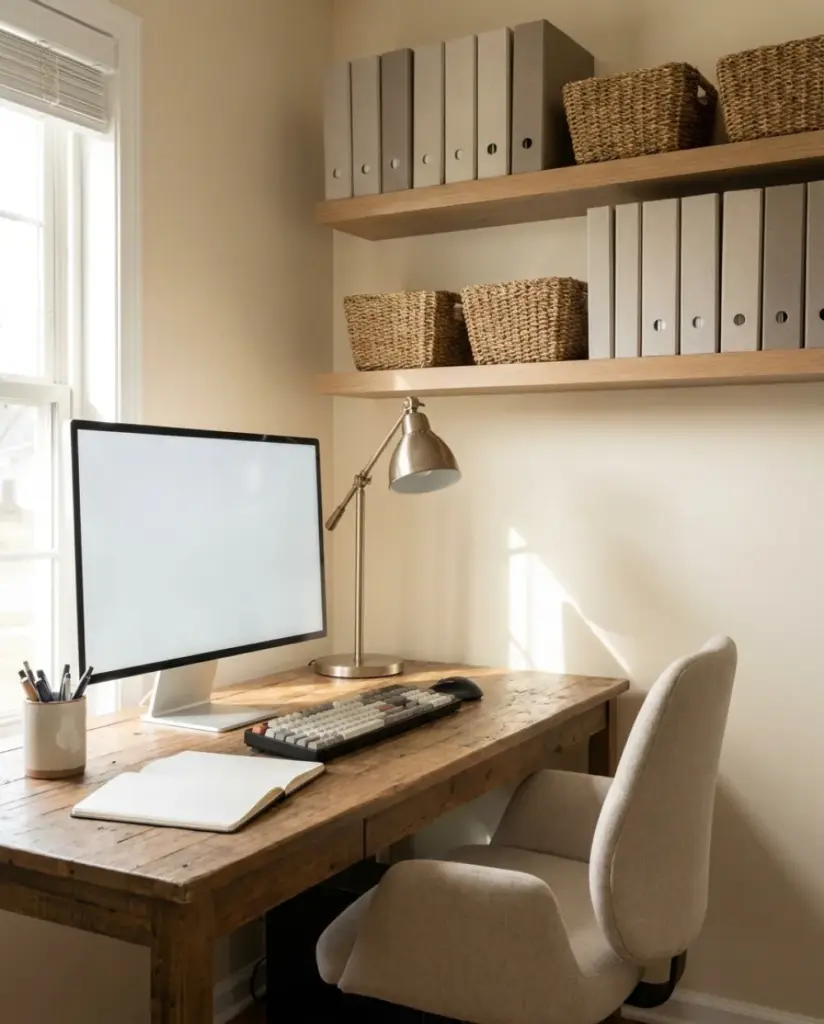
1. How do you start organizing a home office?
You start organizing a home office by clearing the desk and drawers completely and sorting everything into three piles: keep in the office, relocate to another room, and let go. Starting from an empty desk shows how much space you have and which items actually belong in a workspace.
- Keep: tools and files you use daily or weekly for work
- Relocate: household items, kids’ things, mail for other rooms and spare cords
- Let go: dried pens, broken gadgets, outdated manuals and duplicate supplies
Professional organizers use the same sort-first rule in whole-home organizing, because containers only help after the volume is known. Once the keep pile is set, the desk surface comes first.
2. What should you keep on a home office desk?
Keep only the items you touch every workday on a home office desk: your computer, a notepad, a pen cup, a lamp and one tray for papers in progress. A clear desk surface gives you room to work and makes the end-of-day reset fast.
- Computer, monitor, keyboard and mouse
- One notebook and a cup with three or four pens
- A desk lamp for task lighting
- One inbox tray for papers that need action
- A charging spot for your phone
Everything else moves into drawers, onto shelves or out of the office.
3. How should you lay out a home office?
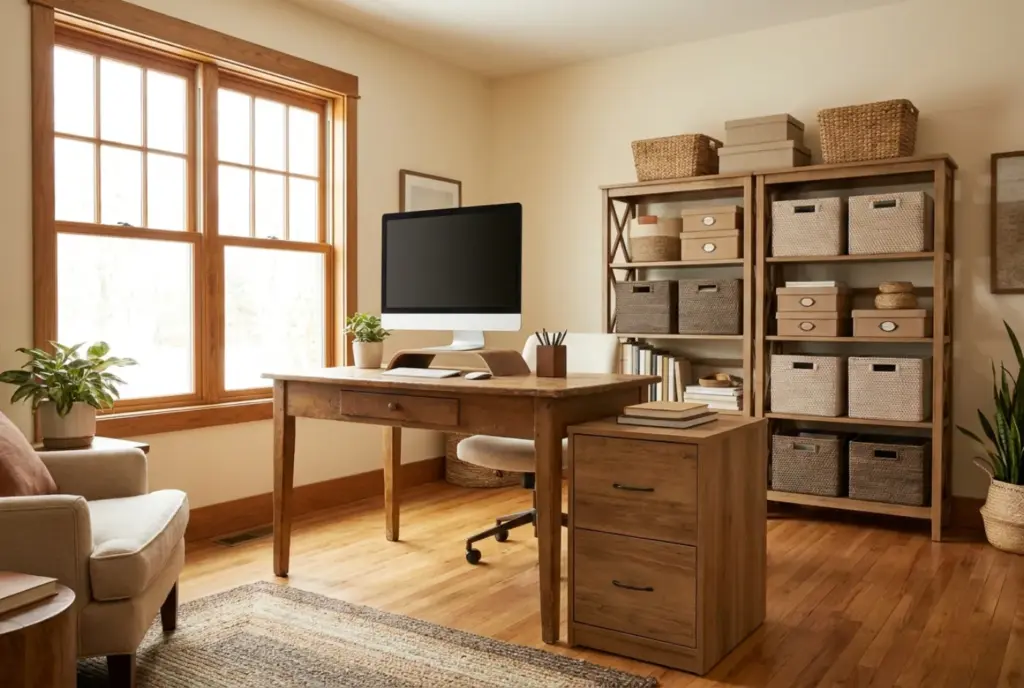
Lay out a home office in three zones: a work zone at the desk, a reference zone for files and books within a short reach, and a supply zone for backstock farther away. A clear layout matters for millions of people, since U.S. Census Bureau data shows the share of people primarily working from home tripled from 5.7 percent in 2019 to 17.9 percent in 2021.
Where should the desk and monitor go?
Place the desk where natural light comes from the side rather than straight behind the screen, which helps reduce glare. OSHA’s computer workstation guidance recommends putting the monitor directly in front of you, at least 20 inches away, with the top line of the screen at or below eye level.
What should every home office have?
- A desk sized to your work and a supportive chair
- Task lighting plus natural light where possible
- A filing drawer, file box or wall file
- A shelf or cabinet for books and supplies
- A wastebasket and a small shredder
4. How do you organize desk drawers and office supplies?
Organize desk drawers by giving each drawer one purpose and using dividers so small office supplies stay sorted. The top drawer holds daily tools, deeper drawers hold files, and extra supplies live in a labeled bin outside the desk.
- Top drawer: pens, sticky notes, tape, scissors and a stapler in a divided tray
- Middle drawer: notebooks, envelopes and stamps
- File drawer: hanging folders for active projects
- Supply bin: backstock paper, ink and spare pens on a shelf or in a closet
The drawer insert ideas in our guide to organizing cabinets and drawers work just as well in a desk.
5. How do you organize paper in a home office?
Organize paper in a home office with a three-step flow: an inbox for new papers, an action file for items in progress and labeled reference files for papers you keep. Paper stays under control when every sheet has one of those three homes.
- Inbox tray or wall slot for new mail and documents
- Action folders for bills to pay, forms to sign and projects
- Reference files grouped by category, such as taxes, home and medical
- A scanning app for receipts you only need to read
Our guide on how to organize paperwork at home covers what to shred, what to keep and how long to keep it. If you claim the IRS home office deduction, keep its records in their own folder, because the space must meet the IRS test of regular and exclusive use.
6. How do you manage cords and cables in a home office?
Manage cords and cables in a home office by plugging everything into one power strip, mounting it under the desk and routing cables through clips or a cable tray. Tidy cords make the room look calmer, keep cables off the floor and make it easy to unplug one device.
- Mount a power strip under the desk or to the back of a leg
- Run cables along a cable tray or adhesive clips
- Bundle long cords with reusable hook-and-loop ties
- Tag each plug with a small color sticker so you know which device it powers
7. How do you use wall space in a home office?
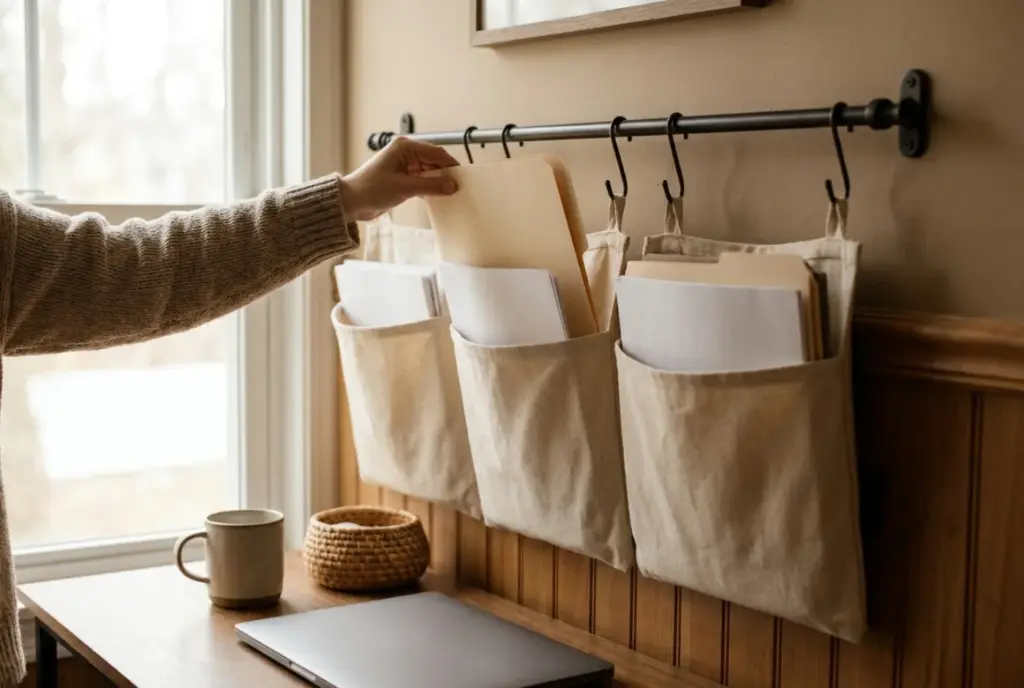
Use wall space in a home office for shelves, a wall file and a pegboard or rail, so books, papers and supplies come off the desk and floor. Vertical storage is the easiest way to add room in a small office.
- Floating shelves for books, binders and baskets
- A wall file or rail with hanging pockets for active papers
- A pegboard for headphones, scissors and small bins
Books and binders stay easy to find when they are grouped by use, and our bookshelf organizing guide explains how.
8. How do you keep a home office organized?
Keep a home office organized with a five-minute reset at the end of each workday and a longer tidy once a week. Small, regular resets stop papers and supplies from building up across the desk.
- File or toss the papers in the inbox tray
- Return pens and tools to their drawer
- Clear cups, plates and stray items
- Write tomorrow’s top task on the notepad
Keep one lidded basket for quick cleanups, and empty it during the weekly tidy.
How do you organize a home office in a small space?
You organize a home office in a small space by choosing a compact desk, storing up the wall and keeping supplies to one bin. A spare closet, a bedroom corner or a basement nook can all hold a working office.
- A closet with the doors removed fits a desk surface and shelves above
- A wall-mounted fold-down desk works in a guest room or hallway
- A rolling cart holds the whole office in a shared room and tucks away at night
- A narrow bookcase beside the desk replaces a filing cabinet
Our closet organizing guide covers measuring for shelves, which is the first step in turning a closet into an office. In a shared room, set a clear end-of-day signal, such as closing the laptop and rolling the cart away, so work does not spread into family time.
How can an organizer help set up a home office?
An organizer helps set up a home office by sorting with you, planning the layout around how you work and building paper and supply systems you can keep up. Many people who work from home also want a space that feels finished, not just functional.
Kalli Erwin and the Just Right Organizing team research desk organizers, files and shelving and send shopping links so you buy only what fits. In-person sessions serve Troy, Illinois and the surrounding Metro East, with donation haul-away included. Our article on whether hiring a professional organizer is worth it explains how sessions work.
Frequently asked questions
What is the best way to arrange a home office?
The best way to arrange a home office is to place the desk near side light, keep daily tools within arm's reach and store files and backstock in separate zones. Put the monitor directly in front of you with the top of the screen at or below eye level.
How do you organize a home office on a budget?
Organize a home office on a budget by sorting and relocating items first, then reusing jars, shoeboxes and kitchen drawer inserts for supplies. Buy only the pieces that solve a problem left after the sort, such as a file box or cable clips.
Where should a home office go in a house?
A home office works best in a quiet room with natural light, a door if you take calls, and an outlet near the desk. A spare bedroom, a converted closet or a corner of the dining room can all work.
How often should you clean out a home office?
Reset the desk daily, tidy the office weekly and clean out files once a year, ideally after tax season. A yearly purge clears old files, dried pens and outdated equipment.
Ready for an office you want to work in?
A home office stays organized when its systems match your work. Kalli and the Just Right team plan the layout with you, set up files and supplies, and take donations away when the session ends. Request a free organizing consultation to get started.
Articles are researched and drafted with AI-assisted tools, illustrated with AI-generated images, and reviewed by Kalli Erwin before publishing.