

How do you organize a bookshelf?
To organize a bookshelf, take every book off, sort out the ones you will not keep, choose one system such as author, genre, color, or size, and shelve heavy books low with similar sizes standing upright together. Finish by adding a few objects and some open space so the shelf is easy to browse. That order works for one bookcase or a whole wall of built-ins, and it is the same order our team uses during home organizing sessions.
- Take every book off the bookshelf and clean the shelves.
- Sort books into keep, donate, and sell piles.
- Choose one system for organizing books.
- Put heavy books on the bottom shelves and anchor the bookshelf.
- Shelve books upright and group them by size.
- Style the bookshelf with objects and open space.
1. Take every book off the bookshelf and clean the shelves
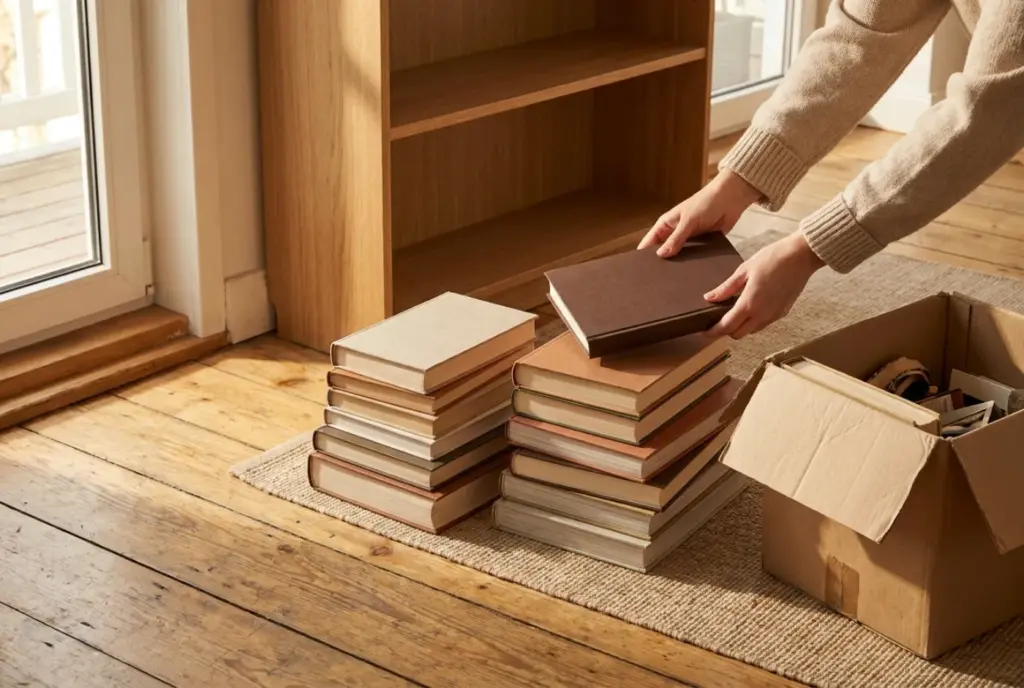
Taking every book off the bookshelf and cleaning the empty shelves is the fastest way to see how many books you own and how much bookshelf space you really have. Stack the books on the floor or a table, shelf by shelf, so nothing gets mixed up. An empty bookshelf also shows whether the case needs a new spot in the room, away from a sunny window or a heating vent.
- Dust each empty shelf with a soft cloth.
- Check shelves for splinters, nails, or sagging boards.
- Measure shelf heights so tall books have a home.
- Gather books living elsewhere in the house, such as nightstands and the car.
2. Sort books into keep, donate, and sell piles
Sorting books into keep, donate, and sell piles shrinks the collection to the books you will read, reference, or treasure. Hold each book and decide quickly:
- Keep: favorites, references you use, books you plan to read this year, and family keepsakes.
- Donate: books in good condition you finished and will not reread.
- Sell: collectible editions, textbooks, and newer hardcovers.
- Recycle: books with water damage, mold, or loose pages.
Box donations right away and put them by the door or in the car so they leave the house. Book sorting goes faster when it is part of a larger reset; our guide on paring down the whole house uses the same keep, donate, and sell decisions room by room.
3. Choose one system for organizing books
The best system for organizing books is the one that matches how you look for them. Pick one system per bookshelf and keep it consistent.
If two people share the shelves, agree on the system before shelving so books go back to the same place. Systems can also differ by room: genre in the living room, author in the office, and size or color on a display shelf.
By author
Alphabetize fiction by the author’s last name. This works best for readers who search by writer and own several books by each.
By genre or subject
Group mysteries, history, cooking, and so on. Most families with mixed collections find books fastest this way.
By color
Arrange spines in a color gradient for a striking look. It is harder to find a specific title, so it suits display shelves more than working libraries.
By size
Group tall art books, hardcovers, and paperbacks separately for clean lines. Size also protects the books, since neighbors of the same height support each cover.
4. Put heavy books on the bottom shelves and anchor the bookshelf
Put heavy books on the bottom shelves and anchor the bookshelf to the wall, because a top-heavy bookcase can tip. Safe Kids Worldwide recommends securing furniture to the wall with anti-tip brackets, braces, or wall straps and keeping heavier items on lower shelves.
- Load encyclopedias, oversized books, and box sets on the lowest shelf.
- Keep the top shelf for light paperbacks and small objects.
- Avoid placing tempting items up high where children might climb to reach them.
5. Shelve books upright and group them by size
Shelve books upright and group books of similar size side by side on the bookshelf so each cover supports its neighbors. The Library of Congress guide to storing books advises keeping shelved books upright, using bookends to stop leaning, and storing books too large to stand flat. If a tall book must stand, rest it on its spine, never spine up.
- Use bookends at the end of every partial row.
- Do not pack books so tightly that pulling one tears the cover.
- Keep the bookshelf out of direct sunlight to stop spines from fading.
- Choose a room that stays cool and dry; the Library of Congress suggests 70 degrees Fahrenheit or below and 30 to 55 percent relative humidity for most books.
6. Style the bookshelf with objects and open space
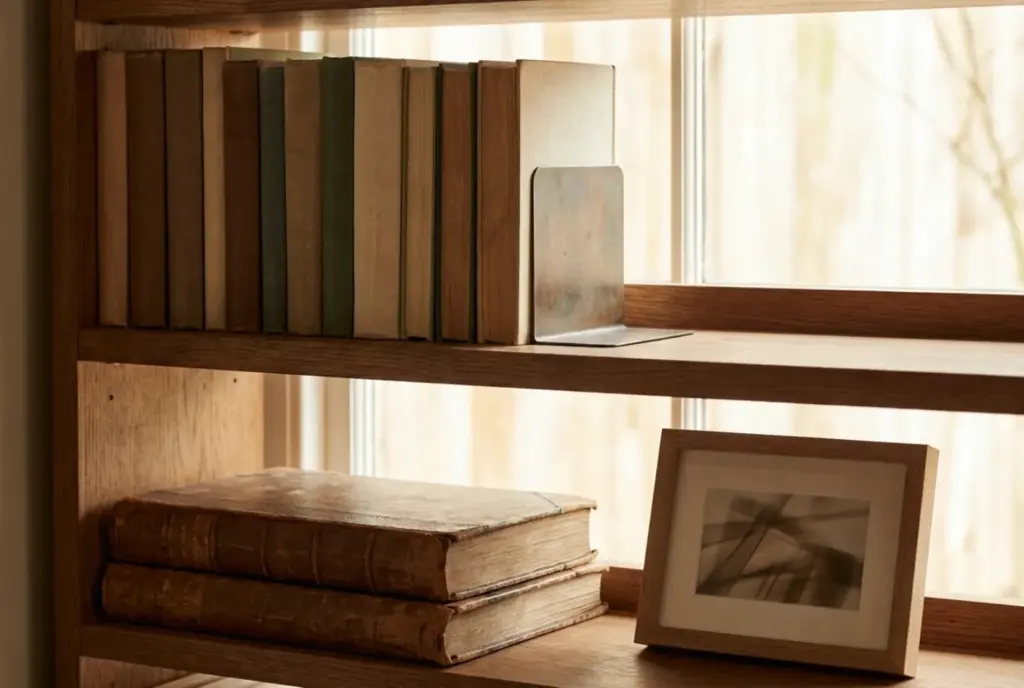
Styling a bookshelf with a few objects and some open space makes it easier to browse and calmer to look at. Aim for function first, then add decor in small groups.
- Mix rows of upright books with a few short horizontal stacks.
- Use a horizontal stack as a base for a plant, photo, or small bowl.
- Group decor in odd numbers, often threes, so it reads as one arrangement.
- Leave some space on each shelf for new books.
Step back after finishing each shelf and adjust until the spacing looks even from across the room.
Should books be stored vertically or horizontally?
Most books should be stored vertically, standing upright on the shelf with bookends for support. Oversized books that cannot stand without leaning are the exception and should lie flat and fully supported. Short horizontal stacks of two to four books also work well as part of shelf styling, as long as the heaviest book sits on the bottom.
How do you organize a bookshelf in a kids’ room?
To organize a bookshelf in a kids’ room, keep favorites at the child’s eye level, face some covers forward, and rotate books every few weeks. Children choose books by cover more than by spine.
- Use low shelves or a forward-facing book ledge for picture books.
- Store board books in a bin on the floor.
- Anchor every bookshelf in a kids’ room.
- Keep a small basket for library books so they go back on time.
Books often share space with toys, so the bins and zones in our guide on organizing toys and a playroom pair well here, and our guide on how to organize a small bedroom shows how to fit a bookshelf into a tight room.
How do bookshelves fit into a whole-home organizing plan?
Bookshelves usually connect to every room in a whole-home organizing plan, because books drift into nightstands, offices, kids’ rooms, and storage boxes. Kalli Erwin and the Just Right Organizing team implement functional systems across Alton, Troy, Edwardsville, and the Illinois Metro East, and books are often part of that work.
- We gather books from every room, sort them with you, and shelve them by the system you choose.
- Kalli shares product research and shopping links for bookends and bins, and you buy what you want.
- Donation haul-away is included each session, so donated books leave the same day.
After a move, books are often the last boxes opened; our guide on how to unpack after moving covers where they fit in the unpacking order.
Frequently asked questions
Should books be pushed to the back of a bookcase?
No, books look and work best pulled toward the front edge of the shelf, with spines lined up. Front alignment keeps titles easy to read and leaves space behind for airflow.
Is it bad to organize books by color?
Organizing books by color is not bad, but it makes specific titles harder to find. It suits display shelves, while genre or author order suits shelves you use often.
Where should you not store books?
Do not store valued books in basements, attics, or garages, which the Library of Congress calls unsuitable because of temperature, humidity, and leak risk. Choose a cool, dry living space instead.
How do you dust books on a bookshelf?
Dust books and shelves with a dry, unscented duster or a vacuum brush on low suction, as the Library of Congress suggests. Regular dusting also discourages pests and mold.
How do you organize books you have not read yet?
Give unread books their own shelf or section near where you read. A dedicated to-read shelf keeps them visible so they get read instead of buried.
Want help organizing your books and shelves?
A well-organized bookshelf is often the moment a room starts to feel finished. If you would like hands-on help sorting books and setting up shelves throughout your home, request a free organizing consultation and we will talk it through by phone. Packages start at $850.
Articles are researched and drafted with AI-assisted tools, illustrated with AI-generated images, and reviewed by Kalli Erwin before publishing.