
How do you organize food storage containers?
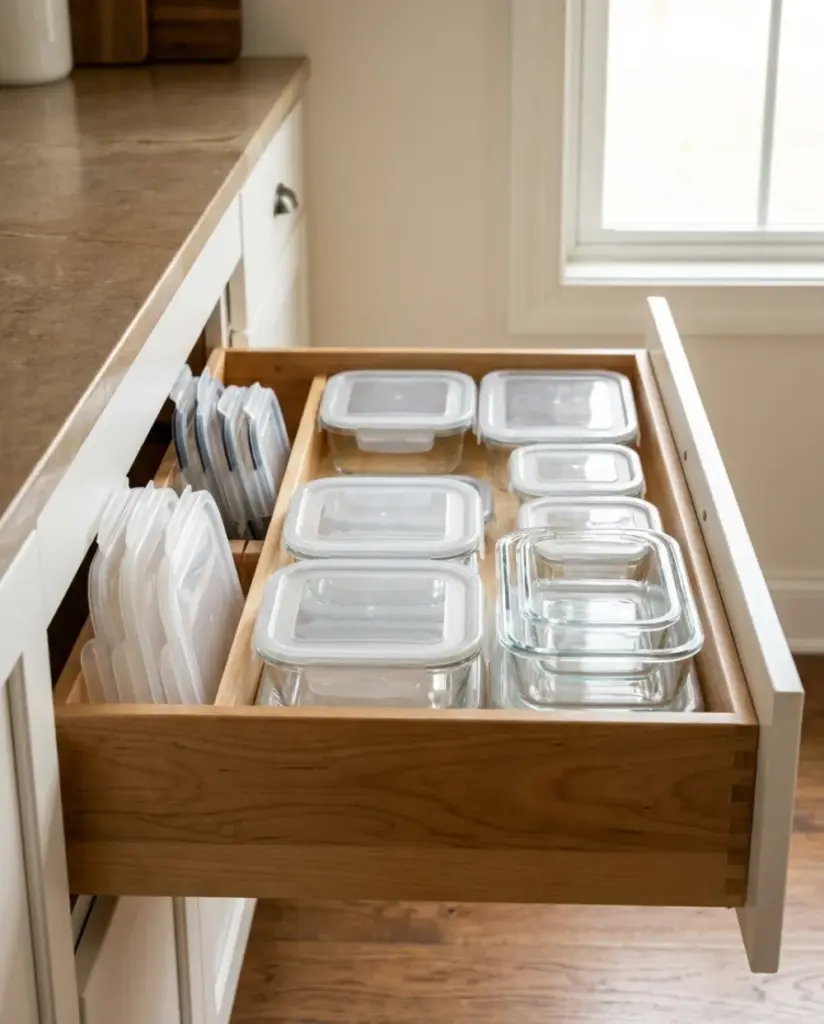
You organize food storage containers in six steps: pull out every container and lid, match each lid to a base, let go of damaged and extra pieces, choose one storage method, give the food storage containers a single home near your prep zone, and contain the lids. Organizing food storage containers is mostly an editing job, since mismatched lids and cracked bases take up the space that a working set needs. Plastics are a big share of that waste: the United States generated more than 35 million tons of plastics in 2018 and recycled only 8.7 percent, according to EPA recycling data.
Step 1: Pull out every container and lid
Empty every cabinet, drawer, and shelf that holds food storage containers, including the lunch box shelf and the stash above the fridge. Wash or wipe anything sticky, and wipe the empty drawer or shelf before anything goes back.
Step 2: Match every lid to a base
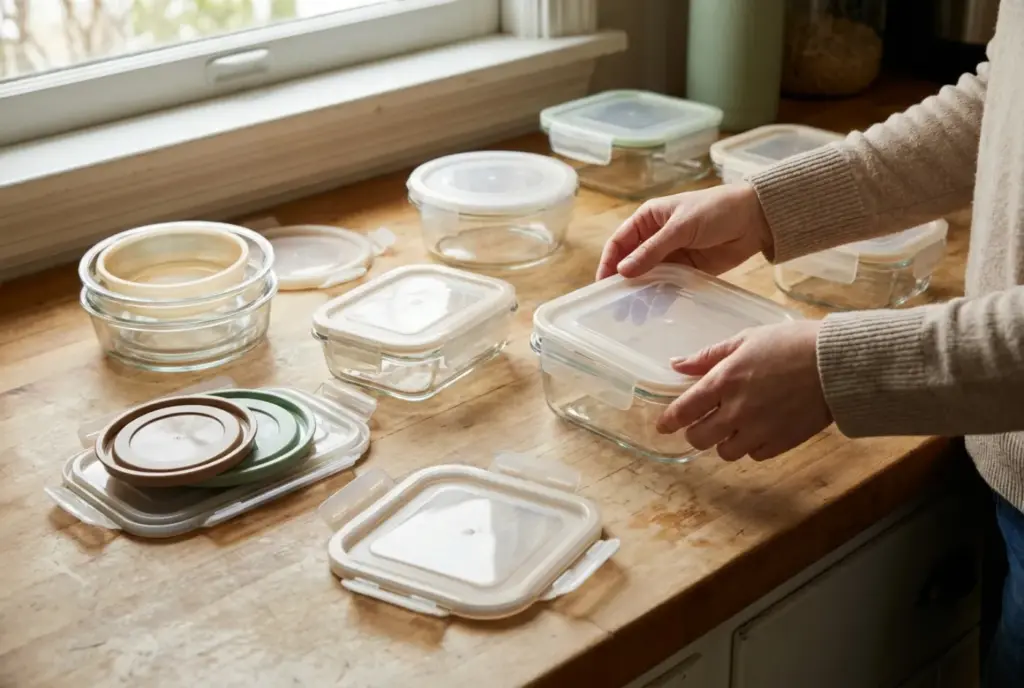
Match each lid to its base and snap them together on the counter. Anything left over is an orphan. A base without a lid can become a drawer divider or go to recycling, and a lid without a base has no job at all.
Step 3: Let go of damaged and extra containers
Let go of containers that are cracked, warped, cloudy, stained, or holding onto old odors. Then keep only the number you use in a normal week, plus a few for leftovers from a big meal. Check your local program before tossing plastic in the recycling bin, since curbside programs differ in which plastic types they accept.
Step 4: Choose one storage method
Choose one method and use it for the whole collection. Three methods work in most kitchens:
- Nest and file: stack bases by shape and size, and stand lids upright in a separate holder
- Lids on: snap each lid onto its base before storing, which limits the set to what fits
- Drawer grid: lay bases and lids flat in a deep drawer with adjustable dividers
Step 5: Give containers one home near the prep zone
Store food storage containers in one spot between the fridge and the counter where you pack leftovers. A deep drawer or a lower cabinet beside the dishwasher makes unloading quick. Planning zones like this is the starting point for any kitchen organizing project, because it puts every tool where the work happens.
Step 6: Contain the lids and set a limit
Contain lids in a bin, file sorter, or lid rack so they stop sliding to the back of the cabinet. Set a limit equal to the space you assigned, and when a new set comes home, an old set leaves. Lids raise their own question, which is whether they belong on the containers at all.
Should food storage containers be stored with lids on or off?
Food storage containers should be stored with lids off and filed separately if the bases nest, and with lids on if the set does not nest or the space is shallow. Lids off saves the most space, because nested bases take up a fraction of the room. Lids on prevents the hunt for a matching top and keeps the collection honest about its size.
Matching lids matter for food safety, not just tidiness. The FDA’s food storage guidance says refrigerated foods should be stored in covered containers and leftovers should go in tight containers.
- Lids off works best for: matching sets that nest, deep drawers, and large collections
- Lids on works best for: glass containers with snap lids, mixed sets, and shallow shelves
- Either way: store lids slightly ajar or fully dry so trapped moisture does not cause odors
A full set of lids also makes it easier to keep a well-organized fridge, with leftovers stacked in clear, covered containers.
How do you organize food storage container lids?
You organize food storage container lids by sorting them by shape and size, then standing them upright in a file sorter, dish rack, or lid organizer. Vertical lids work like files in a cabinet: you see every edge and pull one out without moving the rest. Good lid storage options include:
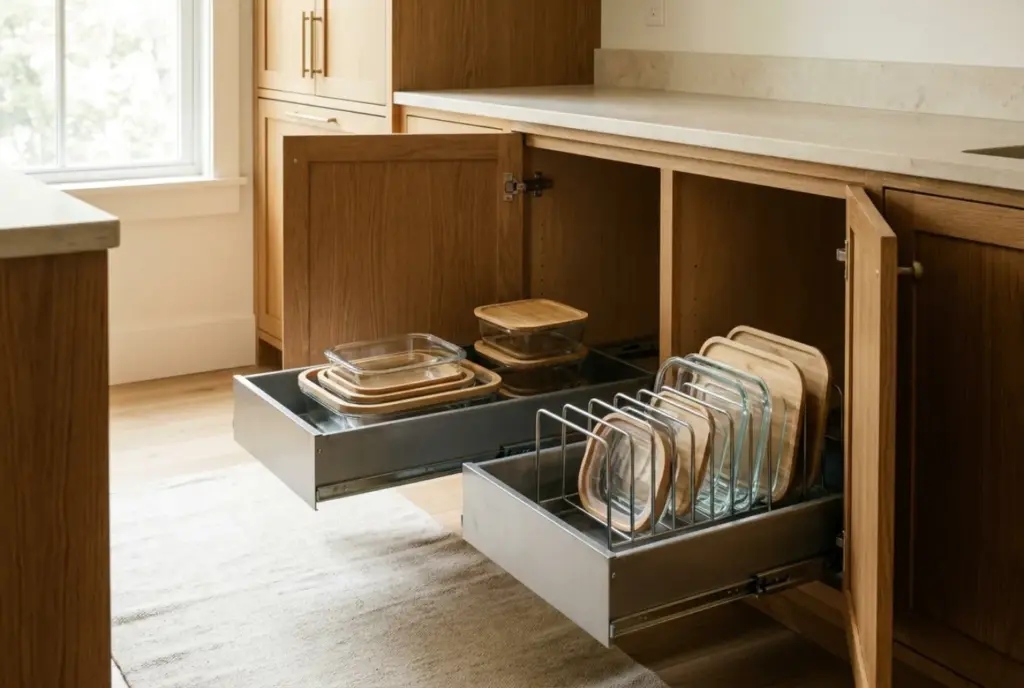
- A metal file sorter or plate rack inside a lower cabinet
- A shallow bin with lids standing on edge, largest at the back
- An adjustable lid organizer with movable dividers
- The bottom layer of a deep drawer, with bases nested on top
Keep each lid group next to its matching bases, the same group-like-items rule that keeps kitchen cabinets and drawers in order. The lid system only works if the container storage around it fits the space.
How do you organize food storage containers in a drawer or cabinet?
You organize food storage containers in a drawer by nesting bases in rows with adjustable dividers, and in a cabinet by using pull-out bins so nothing gets lost in the back. Drawers are easier to see into, while cabinets hold taller stacks. Simple setups for each:
- Deep drawer: nested bases in rows by size, lids filed upright along one side
- Lower cabinet: two pull-out bins, one for bases and one for lids
- Upper cabinet: lightweight sets only, with the most-used sizes on the lowest shelf
- Corner cabinet: a turntable for odd-shaped containers and lunch sets
Store by frequency of use and leave a little breathing room so containers slide in and out easily. In tight kitchens, our tips on organizing a small kitchen show how to find a drawer for containers without giving up prep space.
What kind of food storage containers are best?
Square or rectangular food storage containers that are microwave-safe, freezer-safe, and leak-proof are the best food storage containers for an organized kitchen, because they nest and stack without wasted space. Buy food storage containers in a matching set of two or three sizes, with tight-sealing lids that fit more than one base. The FDA’s microwave oven guidance notes that some plastic containers can melt from the heat of food, so check for a microwave-safe marking before reheating. Features worth checking on any set:
- Glass or plastic bases with clear sides, so you can see leftovers
- Lids that seal tightly and fit more than one base size
- Square or rectangular shapes that nest and stack
- Dishwasher-safe and freezer-safe markings on the base
Are glass or plastic food storage containers better?
Glass and plastic food storage containers each suit different jobs in the kitchen. The main difference is durability versus weight. Glass containers resist stains and odors, handle reheating well, and often go from fridge to oven, but they are heavy and can break. Plastic containers are lighter, cheaper, and easier to pack in a lunch bag, though they can stain, warp, and cloud over time. Many kitchens keep glass for leftovers and meal prep at home, and a small plastic set for lunches and sending food home with guests.
How do professional organizers keep food storage containers in order?
Professional organizers keep food storage containers in order by treating them as one zone in a full kitchen plan, measuring the drawer or cabinet before buying anything, and setting a clear limit for the set. Kalli Erwin and the Just Right team, based in Alton, handle container drawers alongside cabinets, pantries, and counters, so each zone supports the others.
Clients buy any recommended bins, lid organizers, or new container sets themselves, using the product research and shopping links Kalli provides. Donation haul-away is included with each session, so usable extras leave the kitchen the same day. A container system pairs naturally with a pantry organizing plan, since both rely on clear, stackable storage.
Frequently asked questions
How many food storage containers should you keep?
You should keep about as many food storage containers as you use in a normal week, plus a few extra for leftovers from large meals. The space you assign to containers is the limit, so the set never outgrows its drawer or cabinet.
How do you store food storage containers in a small kitchen?
You store food storage containers in a small kitchen by keeping one nesting set, filing lids upright, and using a single deep drawer or pull-out bin. Square containers that stack waste less space than round ones.
Is it better to store food storage containers nested or with lids on?
Storing food storage containers nested saves more space when the bases match, while storing them with lids on works better for mixed sets. Pick one method for the whole collection so everyone in the house puts containers back the same way.
When should you replace plastic food storage containers?
You should replace plastic food storage containers when they crack, warp, stain, cloud over, or hold odors after washing. A lid that no longer seals tightly is another sign the container should go.
What do you do with food storage containers that have no lids?
Food storage containers that have no lids can become drawer dividers, craft bins, or garage organizers, or they can go to recycling if your local program accepts that plastic type. Keeping them in the kitchen only takes space from containers you use.
Want a kitchen where everything has a home?
A container drawer that stays matched is one small piece of a kitchen that works every day. Kalli Erwin and the Just Right team plan kitchen zones, from containers to pantry shelves, for homes across the Metro East, with donation haul-away included. Request a free organizing consultation to talk through your kitchen.
Articles are researched and drafted with AI-assisted tools, illustrated with AI-generated images, and reviewed by Kalli Erwin before publishing.