
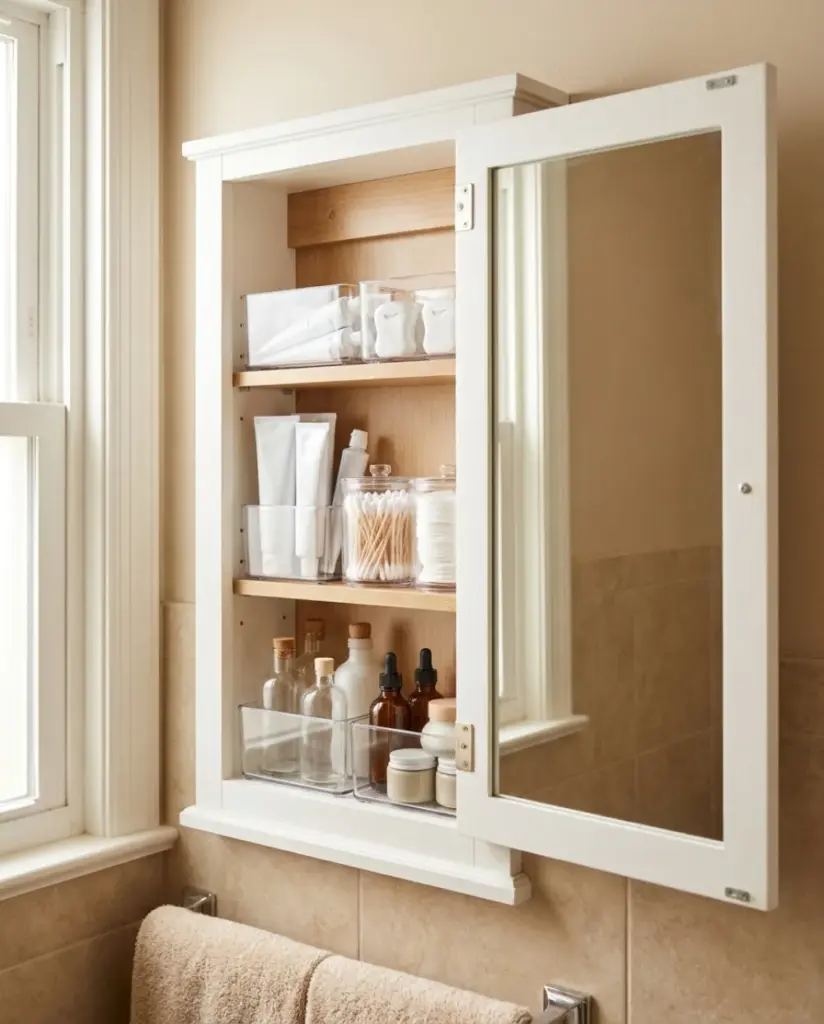
How do you organize a medicine cabinet?
To organize a medicine cabinet, empty it completely, check every expiration date, dispose of expired medicine safely, move moisture-sensitive medicine to a drier spot, and group what stays into small labeled categories. The whole job takes 30 to 60 minutes for most bathroom medicine cabinets. It is one of the fastest wins in any home organizing plan, and the same steps work for a whole-home organizing project room by room.
- Empty the medicine cabinet and wipe the shelves.
- Check expiration dates on every medicine.
- Dispose of expired medicines safely.
- Store medicine in a cool, dry place outside the bathroom.
- Group medicine cabinet items into categories.
- Add bins, risers, and door storage to the medicine cabinet.
- Keep medicine up high and daily items at eye level.
1. Empty the medicine cabinet and wipe the shelves
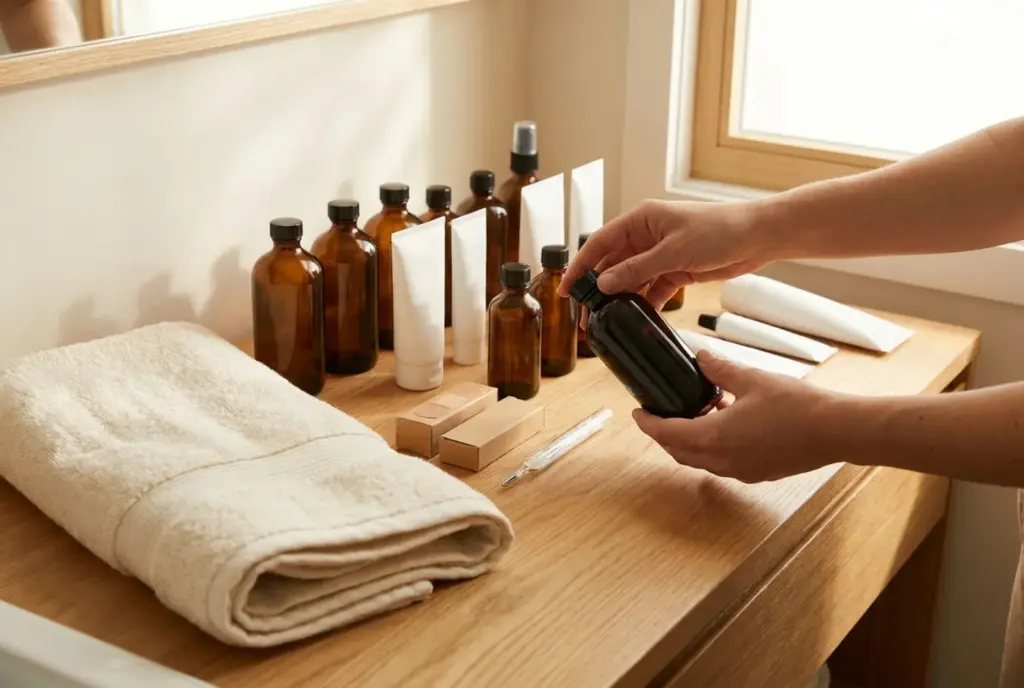
Emptying the medicine cabinet completely is the only way to see every bottle, tube, and sample at once. Set a towel on the counter and line items up as you pull them out.
- Remove every item, including the ones tucked behind the mirror door.
- Wipe shelves and the door with a damp cloth, then dry them fully.
- Check shelf clips and adjust shelf heights to fit tall bottles.
- Pull out empty containers, dried-up products, and hotel samples you will not use.
2. Check expiration dates on every medicine
Checking the expiration date on every medicine is the step most people skip, and it matters. The U.S. Food and Drug Administration has required expiration dates on prescription and over-the-counter medicines since 1979 and warns that expired medicine can lose strength or change in composition. Look for the date printed on the label or stamped on the bottle, sometimes after “EXP.”
- Check pain relievers, allergy pills, cold medicine, and antacids.
- Check eye drops, ointments, and first aid creams.
- Check sunscreen, which also carries an expiration date.
- Set aside anything expired, unlabeled, or no longer prescribed.
3. Dispose of expired medicines safely
Expired medicines should go to a drug take-back site or a prepaid mail-back envelope, not into a donation bag or loose in the trash. The FDA’s medicine disposal guidance lists the safe options in order of preference.
Take-back and mail-back options
- Drop medicine at a take-back kiosk in a retail, hospital, or clinic pharmacy, or a law enforcement facility.
- Use a prepaid drug mail-back envelope.
At-home disposal when take-back is not available
- Flush only medicines on the FDA flush list.
- For everything else, mix the medicine with used coffee grounds, dirt, or cat litter, seal it in a bag or container, and put it in household trash.
Scratch out personal information on empty prescription bottles before recycling or tossing them.
4. Store medicine in a cool, dry place outside the bathroom
Store most medicine in a cool, dry place outside the bathroom, because shower steam and heat in a bathroom medicine cabinet work against it. The FDA notes that a damp bathroom cabinet can reduce a medicine’s effectiveness before its expiration date and suggests a cool, dry place such as a dresser drawer, closet shelf, storage box, or a kitchen cabinet away from the stove and sink.
- Move out: pills, capsules, vitamins, and supplements.
- Check the label: some medicines need refrigeration.
- Keep in the bathroom: toothpaste, floss, skin care, contact lens supplies, and small first aid items.
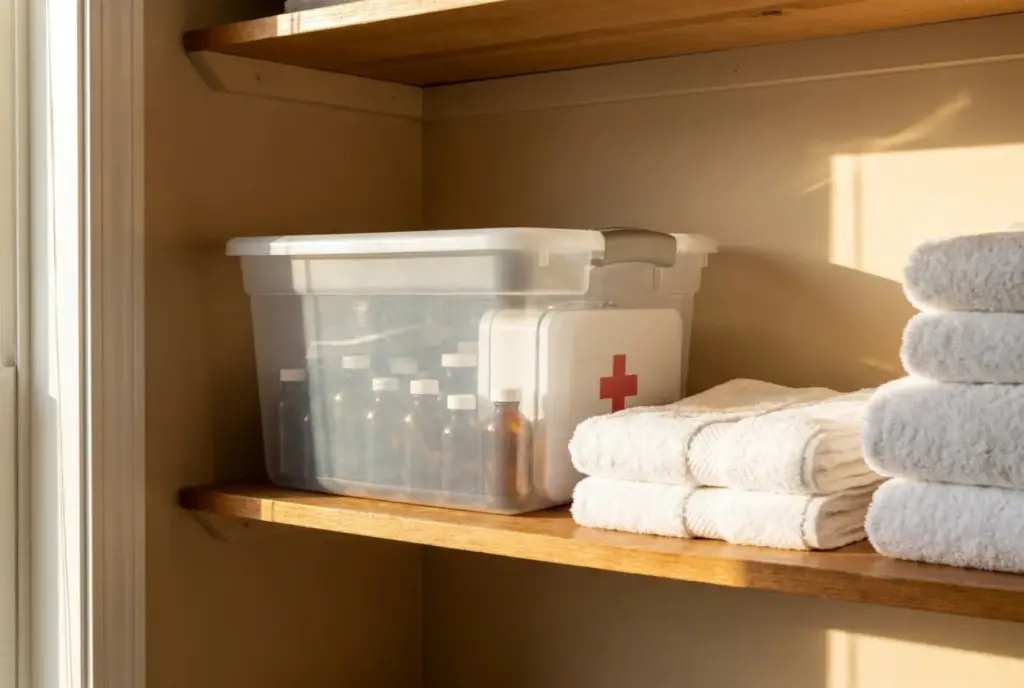
A lidded bin on a high linen closet shelf makes a good home for the medicine you move out.
5. Group medicine cabinet items into categories
Grouping medicine cabinet items into a few categories means anyone in the house can find a bandage or a toothbrush head without searching. Keep categories broad and use the same ones in the bathroom and in the medicine bin you moved out:
- Daily care: toothpaste, floss, deodorant, razors.
- Skin and face: moisturizer, sunscreen, lip balm.
- First aid: bandages, antiseptic wipes, tweezers, small scissors.
- Eyes and ears: contact lens solution, cases, cotton swabs.
- Pain and fever, cold and allergy, stomach: for the moved-out medicine bin.
6. Add bins, risers, and door storage to the medicine cabinet
Adding small clear bins, short risers, and door storage to the medicine cabinet turns a shallow cabinet into usable storage. Measure shelf depth and height first, since recessed cabinets are shallow and a bin that sticks out keeps the door from closing.
- Narrow clear bins: one per category, labeled on the front.
- Short risers: lift back-row items so labels show.
- Small turntables: useful in deeper wall-mounted cabinets.
- Adhesive door cups or a magnetic strip: hold tweezers, nail clippers, and bobby pins.
7. Keep medicine up high and daily items at eye level
Keep all medicine up high and out of children’s sight, and put the daily items each person uses at eye level. The Up and Away campaign reports that about 35,000 young children go to the emergency room each year after getting into medicine left within reach.
- Store medicine in its original child-resistant container and twist caps until they click.
- Keep vitamins and gummies up high too, since they look like candy.
- Give each family member one bin or one shelf for daily items.
How do you keep a medicine cabinet organized?
A medicine cabinet stays organized when every category has a fixed home and a short review happens on a schedule. Three habits keep it that way:
- One in, one out: when a new tube or bottle arrives, finish or toss the old one before it goes on the shelf.
- A twice-yearly date check: pair it with changing smoke alarm batteries or the start of cold and flu season.
- A take-back bag: keep a small sealed bag in the medicine bin for expired items, then drop it at a pharmacy kiosk on your next errand.
Labels on each bin make the system easy for the whole family to follow, including guests and sitters who need to find a bandage fast.
What should be in a medicine cabinet?
A medicine cabinet should hold the small daily-use items you reach for at the sink, plus a basic first aid kit. A practical list:
- Toothpaste, floss, and spare toothbrush heads.
- Bandages in several sizes and antiseptic wipes.
- Tweezers, nail clippers, and small scissors.
- A thermometer.
- Sunscreen, lip balm, and moisturizer.
Ask a pharmacist which over-the-counter medicines make sense for your household, then store them in the drier spot from step 4.
How does a medicine cabinet fit into a bathroom organizing plan?
A medicine cabinet is usually the first stop in a bathroom organizing plan, because it is small, fast, and used every day. The same categories carry into the vanity, as our guide on how to organize bathroom cabinets shows, and overflow towels and backup supplies fit the system in how to organize a linen closet.
Kalli Erwin and the Just Right Organizing team implement functional systems in bathrooms, closets, and whole homes across Alton, Troy, Edwardsville, and the Illinois Metro East. Kalli shares product research and shopping links for bins and risers, and you buy only what you want. Expired medicine gets set aside for you to take to a take-back site, while donation haul-away each session covers unused items in good condition.
If you are deciding whether a few hours of help is worth it, our guide on whether hiring a professional organizer is worth it lays out what to expect, and the organizing prices and packages page shows how sessions are structured.
Frequently asked questions
Where should you store medicine if not in the bathroom?
Store most medicine in a cool, dry place such as a dresser drawer, a high closet shelf, or a kitchen cabinet away from the stove and sink, as the FDA suggests. Keep it up high and out of children's sight.
How often should you clean out your medicine cabinet?
Clean out your medicine cabinet at least once a year, and check dates again whenever cold and flu season starts. A quick yearly pass catches expired medicine before you need it.
Can you use expired medicine?
No, the FDA advises against using expired medicine because it can be less effective or risky after its expiration date. Take expired medicine to a drug take-back site instead.
Are medicine cabinets in bathrooms outdated?
No, bathroom medicine cabinets are still useful for daily items like toothpaste, skin care, and first aid supplies. They are simply a poor spot for most pills because bathroom humidity can weaken medicine.
How do you organize a medicine cabinet with no shelves to spare?
Use the cabinet door for small tools, add narrow clear bins by category, and move pills and backups to a bin elsewhere. A shallow cabinet then holds only daily items.
Ready for a bathroom that works every morning?
A clear medicine cabinet often sparks the rest of the bathroom, then the linen closet, then the whole house. If you would like hands-on help, request a free organizing consultation and we will talk through your home by phone. Packages start at $850.
Articles are researched and drafted with AI-assisted tools, illustrated with AI-generated images, and reviewed by Kalli Erwin before publishing.