
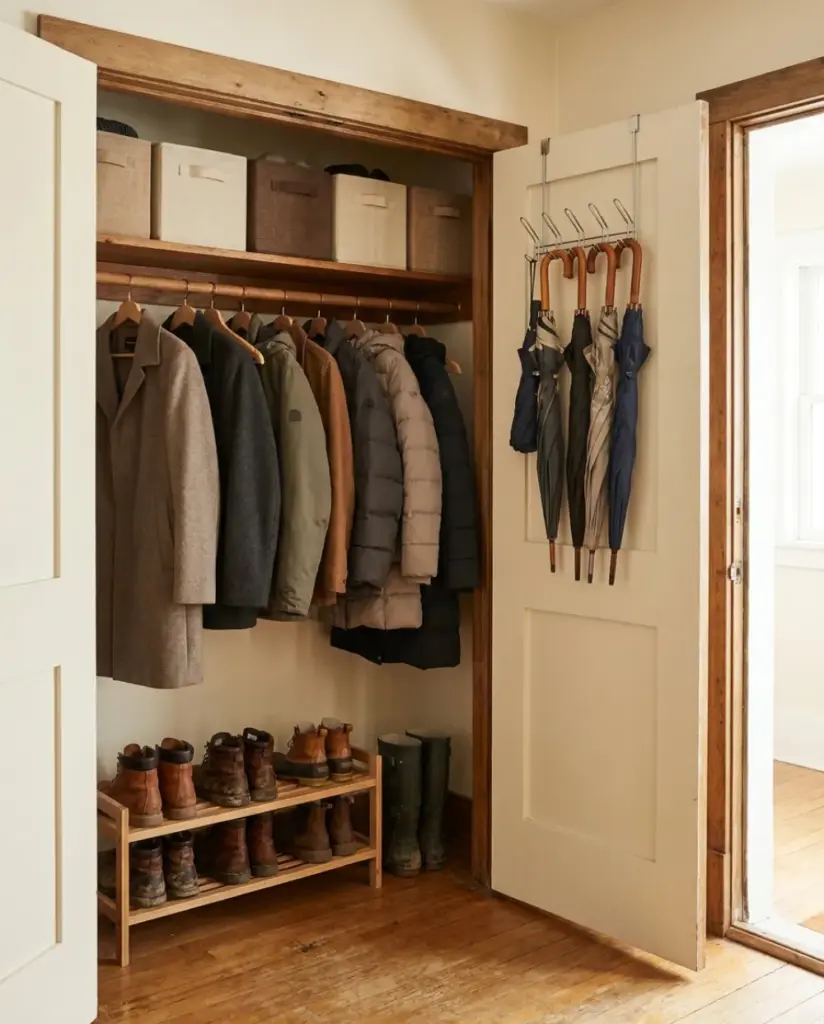
How do you organize a coat closet?
You organize a coat closet in six steps: empty and clean the coat closet, sort coats and gear by person and season, let go of what nobody wears, switch to matching hangers, use the shelf, floor, and door for accessories, and set up a spot for wet gear. Organizing a coat closet works best at the start of each season, when you swap heavy winter coats for lighter jackets. The goal is a coat closet where every person can grab a coat, shoes, and gloves in under a minute on the way out the door.
Step 1: Empty the coat closet and clean it
Take every coat, shoe, bag, and bin out of the coat closet. Vacuum the floor, wipe the shelf and rod, and check corners for forgotten gloves and stray mail. An empty closet shows you the real space you have to work with.
Step 2: Sort coats and gear by person and season
Sort everything into piles by person, then split each pile by season. Current-season coats and shoes stay near the coat closet. Off-season gear moves to a second spot until the weather turns.
Step 3: Let go of coats nobody wears
Let go of coats that no longer fit, have broken zippers, or stayed on the hanger all last winter. Children outgrow coats every year or two, so check sizes each fall. One Warm Coat lists active coat drives by zip code and asks that donated coats be clean and wearable.
Step 4: Switch to matching slim hangers
Switch to matching slim hangers, sturdy enough for heavy winter coats, and hang coats by person from left to right. Matching hangers can free up several inches of rod space and make the row look calm and even. The same rod and hanger logic drives every reach-in project in our closet organizing work.
Step 5: Use the shelf, floor, and door for accessories
Use every surface of the coat closet, not just the rod. Assign each zone one job:
- Top shelf: one bin per person for hats, gloves, and scarves
- Floor: a two-tier shoe rack for everyday shoes and boots
- Back of the door: an over-the-door rack for umbrellas, reusable bags, and leashes
- Side walls: adhesive hooks for backpacks and purses
Step 6: Set up a drip zone for wet coats and boots
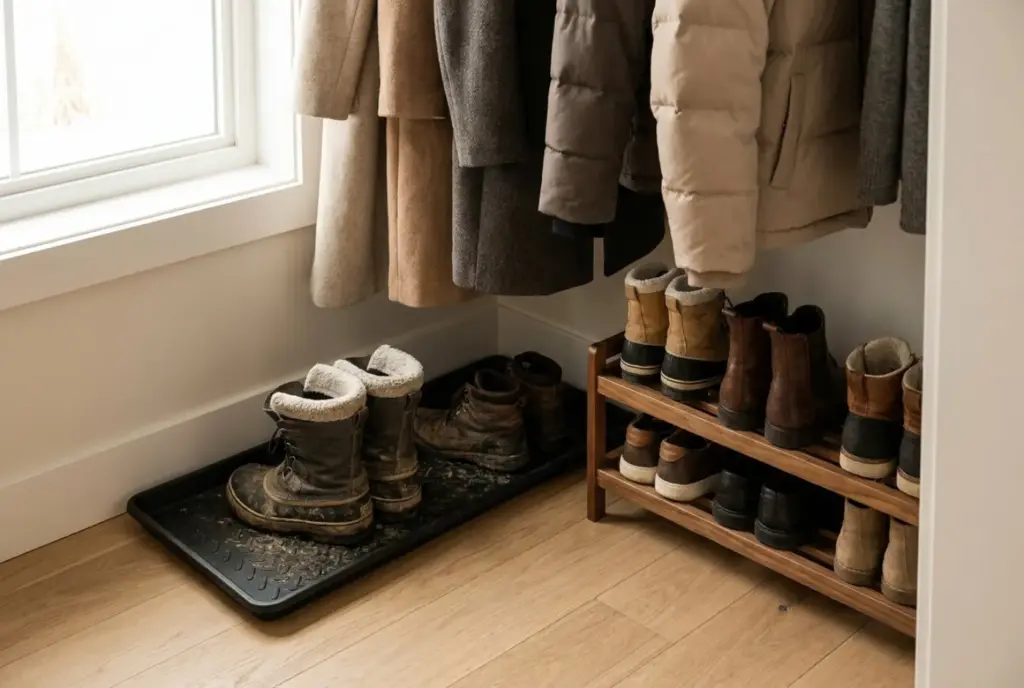
Set up a boot tray on the coat closet floor and leave space for wet coats to dry before the door closes. Metro East winters bring snow, slush, and road salt into the entry, and damp gear in a closed closet can turn musty fast. The EPA’s guide to mold and moisture advises drying wet materials within 24 to 48 hours to prevent mold growth. With the system in place, the next question is what earns a spot in the closet at all.
What should go in a coat closet?
A coat closet should hold the coats, shoes, and accessories each person uses in the current season, plus a few items you grab on the way out the door. Everything else belongs somewhere else in the house. A practical coat closet holds:
- One or two current-season coats per person
- Everyday shoes and boots for each family member
- A bin each for hats, gloves, and scarves
- Umbrellas and reusable shopping bags
- Dog leashes and a small bag of walk supplies
- A home emergency kit near the exit
The coat closet is a natural home for a go-bag, since it sits by the door. The Ready.gov emergency kit checklist recommends basics such as water, food, a flashlight, a first aid kit, and extra batteries. Keeping the closet to these items leaves room to work even in a small space.
How do you organize a small coat closet?
You organize a small coat closet by limiting it to current-season coats, using slim hangers, and adding storage on the door and side walls. Older homes in Alton and Godfrey can have shallow coat closets, so every inch of depth counts. Space-saving ideas:
- Slim hangers to fit more coats on a short rod
- A second, lower rod for children’s coats
- An over-the-door rack instead of floor bins
- A narrow shoe shelf that fits under hanging coats
- A shelf riser to double the top shelf
Shoes take the most floor space in a small coat closet. Our roundup of shoe storage ideas covers slim racks and cabinets that fit tight entries. Clearing out off-season coats frees more room than any product.
Where should you store off-season coats?
You should store off-season coats in a bedroom closet, a guest room closet, or a breathable garment bag or bin in a dry basement or under the bed. Moving heavy winter coats out of the coat closet in spring can open up much of the rod. Clean each coat before storing it, since stains set over the summer.
- Wool and down coats: breathable garment bags on sturdy hangers
- Rain jackets and fleece: folded in lidded bins
- Winter boots: cleaned, dried, and stuffed with paper to hold their shape
- Hats and gloves: washed and packed in one labeled bin per person
Our guide on how to store seasonal clothes walks through cleaning, bags, and rotation dates for the whole wardrobe. Some homes have no coat closet at all, which calls for a different plan.
What can you do if you have no coat closet?
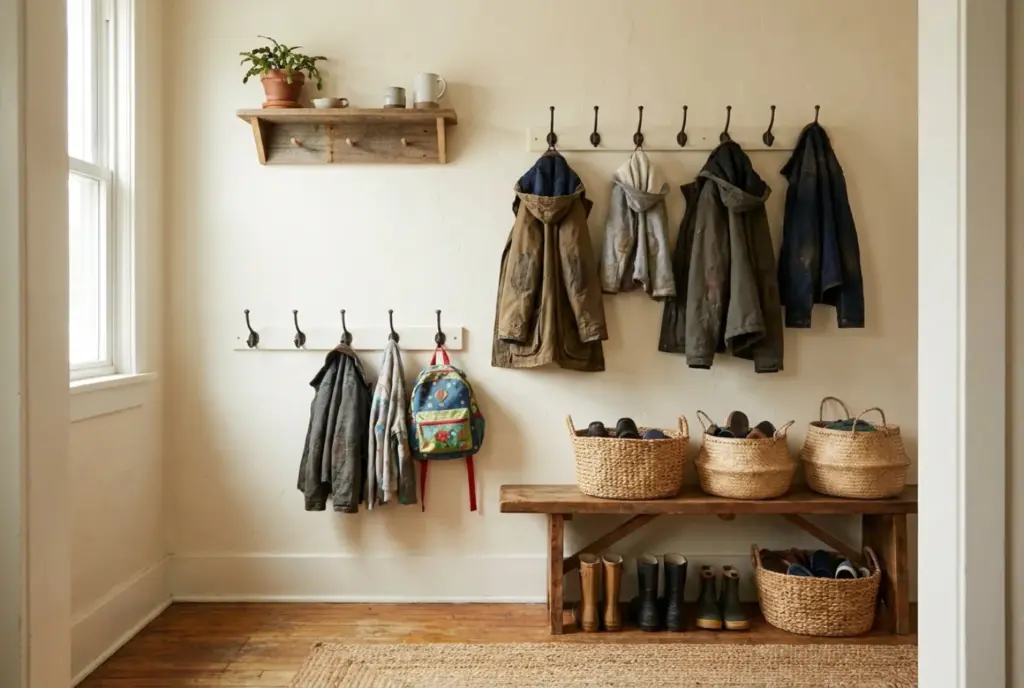
If you have no coat closet, you can create one with wall hooks, a bench with shoe storage, a freestanding wardrobe, or a coat rack near the door. Open-plan layouts and some older homes skip the front coat closet entirely. Options that work:
- A row of sturdy wall hooks at two heights for adults and kids
- A bench with cubbies or baskets for shoes underneath
- A freestanding wardrobe or armoire near the entry
- A wall-mounted shelf with hooks for hats and bags
An entry without a closet still needs clear zones. Our guide to organizing an entryway shows how to fit hooks, shoe storage, and a landing spot for keys into a small wall.
How do you organize a coat closet for kids?
You organize a coat closet for kids by moving their coats, bins, and shoes down to their height, so children can hang up and grab their own gear. A lower rod or a row of hooks at a child’s shoulder height makes the system easy to follow. Kid-friendly coat closet setups include:
- A second rod or tension rod mounted low for children’s coats
- One open bin per child for hats, gloves, and scarves
- A cubby or shelf slot for each child’s school shoes
- Picture labels on bins for children who cannot read yet
Keep backpacks on hooks near the closet rather than inside it, so wet snow gear does not soak homework. Expect a few reminders while kids learn where everything goes.
How does a professional organizer set up a coat closet?
A professional organizer sets up a coat closet by sorting every coat and accessory with the family, measuring the closet, and planning a zone for each person and season. Kalli Erwin and the Just Right team, based in Alton and working in homes across Troy and the Metro East, can pair the coat closet with an entryway or bedroom closet project.
Clients buy recommended hangers, racks, and bins themselves, using the product research and shopping links Kalli provides. Donation haul-away is included with each session, so outgrown coats leave the house that day for donation. For the bigger picture, our closet organizing guide applies the same steps to every closet in the house.
Frequently asked questions
What is the best way to organize coats in a closet?
The best way to organize coats in a closet is to hang only current-season coats on matching slim hangers, grouped by person from left to right. Put accessories in one bin per person on the shelf above.
How many coats should you keep in a coat closet?
Keep one or two current-season coats per person in a coat closet, plus a guest coat if space allows. Off-season coats belong in a bedroom closet or a storage bin until the weather changes.
How do you store gloves and hats in a coat closet?
Store gloves and hats in one bin per person on the coat closet shelf, or in an over-the-door rack with pockets. Bins at kid height help children grab and return their own gear.
What kind of hangers are best for a coat closet?
Sturdy slim hangers with wide shoulders are best for a coat closet, because they hold heavy coats without stretching them and save rod space. Use one style throughout so coats hang at the same height.
How often should you clean out a coat closet?
Clean out a coat closet twice a year, in spring and fall, when you swap seasonal coats. Check sizes for children, donate what no one wears, and vacuum the floor before restocking.
Want an entry closet that works for the whole family?
A coat closet set up by person and season makes busy mornings easier for everyone. Kalli Erwin and the Just Right team organize closets and entryways across the Metro East, with donation haul-away included at every session. Request a free organizing consultation to plan your coat closet.
Articles are researched and drafted with AI-assisted tools, illustrated with AI-generated images, and reviewed by Kalli Erwin before publishing.