
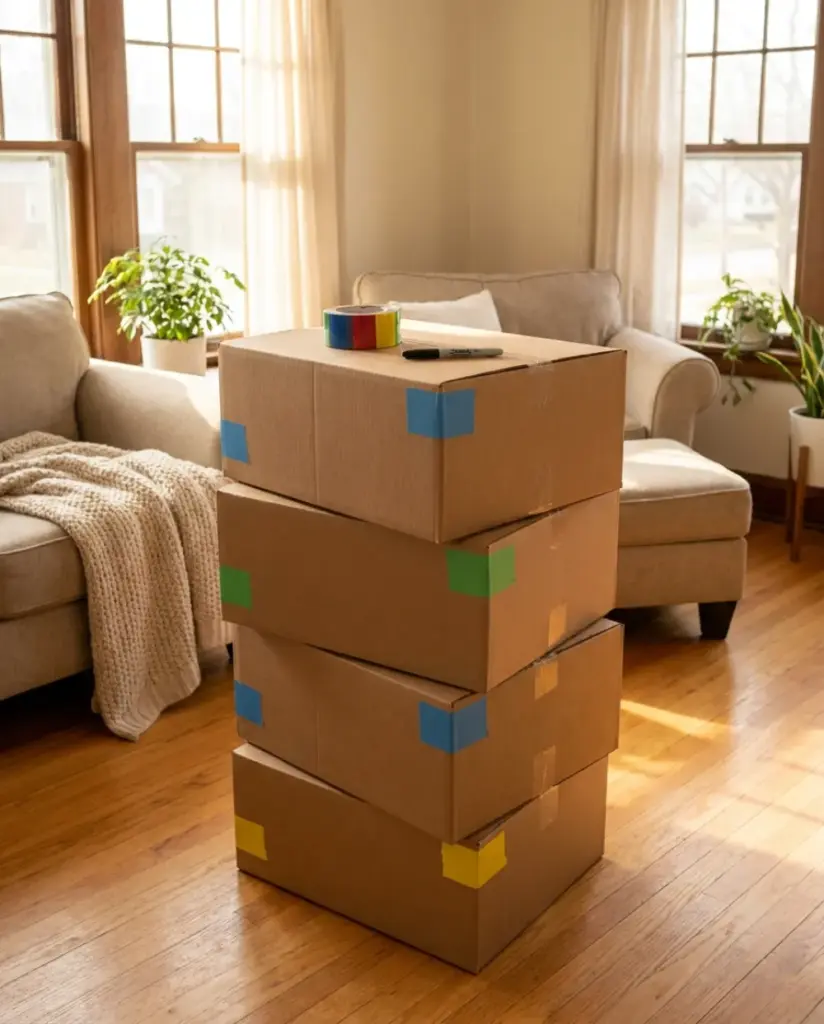
How do you label moving boxes?
To label moving boxes, write the destination room, a short contents list, and a box number on the top and at least two sides of every box, then log each number in one inventory list. Add a room color and a fragile or open-first mark where it applies. Those four details let anyone carrying a box set it down in the right room without asking.
The method below is the same one our team follows when we provide packing services for families across the Metro East:
- Gather labeling supplies before you pack.
- Color code moving boxes by room.
- Write the room, contents, and box number on each moving box.
- Label moving boxes on the top and two sides.
- Mark fragile and open-first boxes.
- Keep a numbered moving box inventory.
1. Gather labeling supplies before you pack
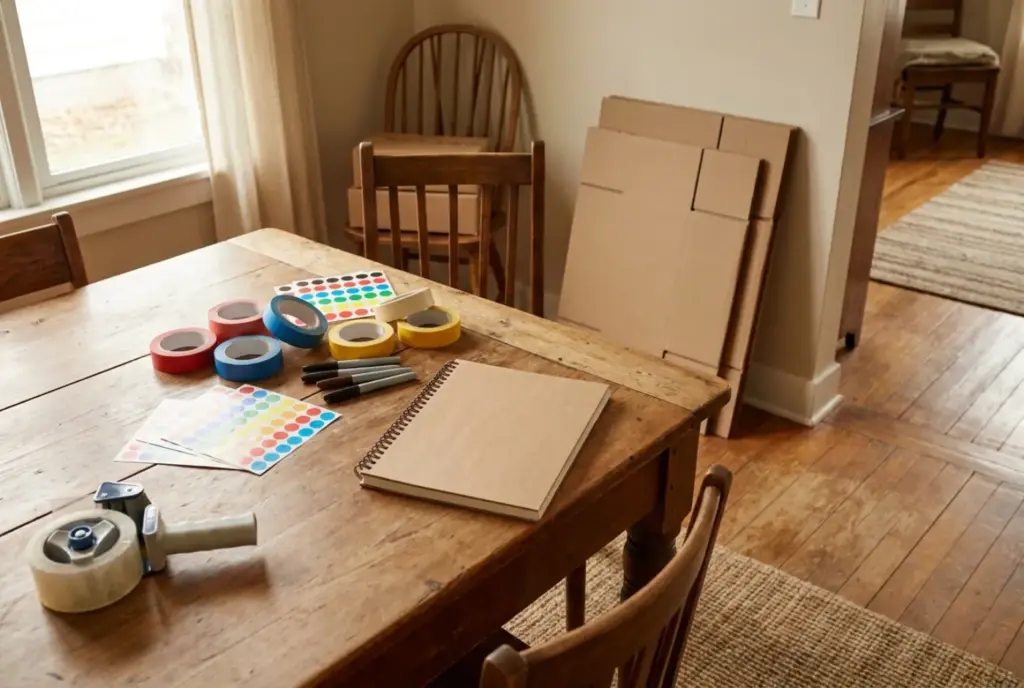
Gathering labeling supplies before you pack keeps every box labeled the moment it is taped, not hours later from memory. Set up one labeling station with everything in a small bin:
- Two or three thick, dark permanent markers.
- Colored tape, dot stickers, or colored markers, one color per room.
- Blank shipping labels or large sticky labels if you prefer printed labels.
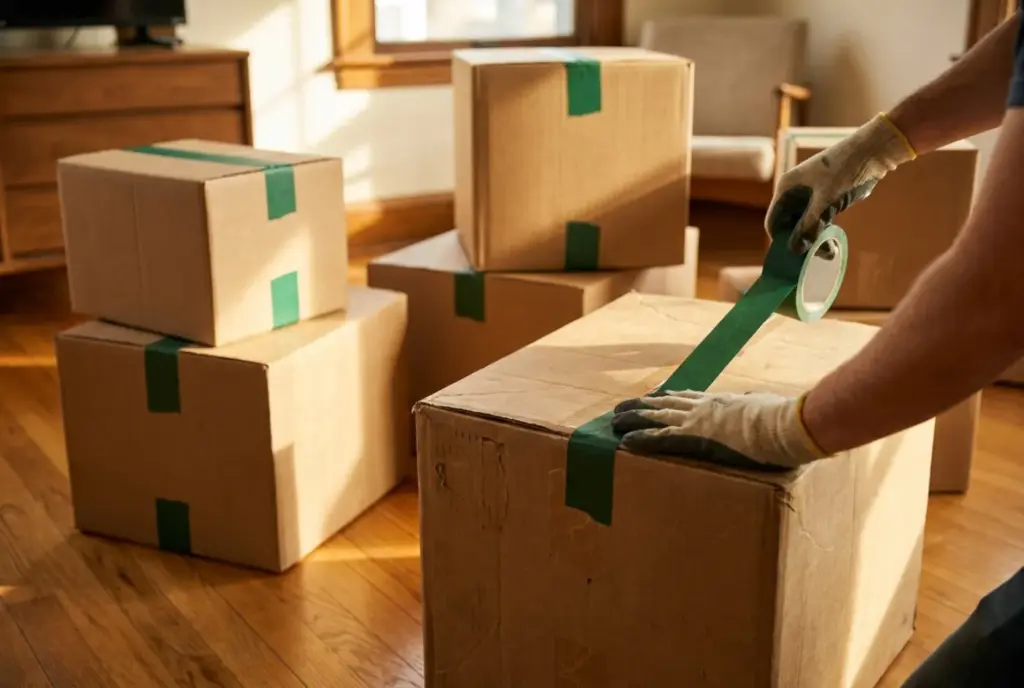
- Clear packing tape to cover paper labels so they do not tear or smudge.
- A notebook, spreadsheet, or phone note for the box inventory.
Keep the station in one spot, such as the dining table, so the supplies never wander off with a box.
2. Color code moving boxes by room
Color coding moving boxes by room, with one name and one color for each room in the new home, makes every moving box label readable from across a garage. Use the room names of the new house, not the old one, because that is where every box is going.
- Use full words: write “Primary Bedroom” or “Kids Bath,” not “MBR” or “BA,” since abbreviations confuse helpers.
- Pick distinct colors: for example, blue for the kitchen, green for the living room, yellow for the primary bedroom.
- Post a color key: tape a matching color square on each doorway of the new home so movers and friends can match boxes to rooms.
- Add a room for storage: give the garage or basement its own color so those boxes skip the main floor.
Color does the sorting at a glance, while the written label supplies the detail. Buy enough tape or stickers in each color for every box in that room before you start, because running out mid-move breaks the system.
3. Write the room, contents, and box number on each moving box
Each moving box label needs three details written in the same order on every box: the destination room, a short contents list, and a unique box number. Each detail answers a different question on moving day and unpacking day.
Destination room
Write the room in large letters at the top of the label. Movers read this first, so it should be the biggest word on the box.
Contents list
List the three or four main items, such as “Kitchen: baking pans, mixing bowls, measuring cups.” Skip vague words like “stuff” or “misc.” Avoid listing valuables on the outside of a box; keep jewelry, documents, and medications with you instead.
Box number
Number boxes in order as you seal them, such as “Kitchen 12.” The number is what ties each box to your inventory list.
4. Label moving boxes on the top and two sides
Label moving boxes on the top and on two adjacent sides, because stacked boxes hide their tops and boxes on a dolly hide one side. Two side labels mean at least one label faces out no matter how a box lands in the truck or the garage.
- Put the color mark on the same corner of every side.
- Keep labels away from seams so tape and box cutters do not slice through them.
- Cover paper labels with clear packing tape.
- Write the room on any plastic bin lid and on the bin itself, since lids get separated.
5. Mark fragile and open-first boxes
Fragile and open-first boxes need a second mark so they get careful handling and fast unpacking. Write “Fragile” and “This Side Up” with arrows on dishware, glass, lamps, and framed art. Pack heavy items in small boxes and light items in large ones so no fragile box gets crushed.
Open-first boxes hold what you need on night one. Pack one per person plus one for the kitchen and bath:
- Toiletries, towels, and a shower curtain.
- Sheets, pillows, and a change of clothes.
- Chargers, basic tools, scissors, and paper towels.
- A coffee maker, a few dishes, and snacks.
Load open-first boxes last so they come off the truck first.
6. Keep a numbered moving box inventory
A numbered moving box inventory tells you exactly how many boxes left the old house and whether every one arrived. A simple table is enough:
| Box number | Room | Contents | Arrived |
|---|---|---|---|
| Kitchen 12 | Kitchen | Baking pans, mixing bowls | Check |
| Office 3 | Office | Printer paper, files, desk lamp | Check |
Count boxes off the truck against the list before the movers leave. Our packing checklist for moving lists what to pack in each room and when, so the inventory fills in as you go.
How do you label reused boxes and plastic bins?
Reused boxes and plastic bins need old marks hidden and new labels that stick. Scribble out or tape over every old room name and shipping label so a box from a past move does not land in the wrong room.
- Reused cardboard: cover old writing with blank tape, then label fresh.
- Plastic bins: use painter’s tape or label sleeves, since paper labels slide off smooth plastic.
- After the move: flatten boxes for reuse or recycling.
Cardboard is one of the most recycled materials in the country. EPA data shows corrugated boxes had a 96.5 percent recycling rate in 2018, so flattened boxes have a clear next life. Unopened pantry food can go further too: Move For Hunger works with more than 1,200 moving companies that collect unopened, non-perishable food and deliver it to local food pantries, so a box labeled “Donate: Food” is worth packing.
How do labeled boxes make unpacking faster?
Labeled boxes make unpacking faster because every box already sits in the right room with its contents listed. Instead of opening boxes to find the coffee maker, you unpack in priority order: open-first boxes, then the kitchen, then bedrooms, then storage.
Our guide on how to unpack after moving walks through that order room by room. If you are moving to a smaller home, the downsizing checklist helps you decide what deserves a box before labeling starts.
How do professional packers label moving boxes?
Professional packers label moving boxes with the same room, contents, and number system, applied the same way on every box so nothing depends on memory. The Just Right Organizing team packs, labels, and inventories homes in Alton, Edwardsville, Troy, and the surrounding Illinois Metro East.
- We pack and label room by room, with an inventory you keep.
- Our unpacking and home setup service places each labeled box and sets up closets, kitchens, and drawers.
- Donation haul-away is included each session for items you decide not to move.
We do not transport belongings, so your moving company handles the truck while we handle the packing and setup.
Frequently asked questions
Should you label moving boxes by room or by contents?
Label moving boxes by both room and contents. The room tells movers where the box goes, and the short contents list tells you which box to open first.
Do movers need labels on every box?
Yes, movers need a label on every box to place it in the right room without asking. A room name and color on the top and two sides is enough for movers; the contents list is mainly for you.
Should you number moving boxes?
Yes, number every moving box and record each number in an inventory list. Numbers make it easy to confirm every box arrived and to find one specific box later.
How do you get labels to stick to plastic moving bins?
Painter's tape, label sleeves, or labels covered with clear packing tape stick best to plastic bins. Label both the lid and the bin, since lids often get separated.
What should you not write on a moving box?
Do not write valuables, such as jewelry, cash, or electronics, on the outside of a moving box, because a label like that advertises what is inside. Keep valuables, documents, and medications with you during the move.
Want help packing and labeling your move?
A labeled, inventoried move makes the first week in a new home calmer for everyone. If you would like our team to pack and label your home, request a free organizing consultation and we will talk through your move by phone. Packages start at $850.
Articles are researched and drafted with AI-assisted tools, illustrated with AI-generated images, and reviewed by Kalli Erwin before publishing.