
How do you organize cleaning supplies?
You organize cleaning supplies in six steps: gather all your cleaning supplies, sort cleaning supplies by task, edit the cleaning products you no longer use, build a daily cleaning caddy, assign storage zones, and contain each zone in bins. Organizing cleaning supplies is a safety job as much as a tidiness job, because household cleaning substances topped the list of products in poison center cases for children 5 and under in 2024, with 87,031 cases, according to national poison center statistics.
The steps below work for a single under-sink cabinet or a full cleaning closet.
Step 1: Gather every cleaning product in one place
Pull cleaning supplies from every room onto one clear surface, such as a kitchen table or a towel on the floor. Check the usual hiding spots:
- The kitchen sink cabinet and the bathroom vanities
- The laundry room shelves and the top of the washer
- The hall closet, the basement stairs, and the shelves of a well-organized garage
- Car trunks and the bag of spare products from the last move
Seeing the whole collection at once shows you how many glass cleaners and scrub brushes you actually own.
Step 2: Sort cleaning supplies by task
Sort cleaning supplies by the job they do, not by brand or bottle size. Five groups cover most homes:
- Kitchen: dish soap, degreaser, sponges, and counter spray
- Bathroom: toilet cleaner, tub and tile scrub, and a toilet brush
- Floors: mop heads, floor cleaner, and the broom and dustpan
- Glass and dusting: glass cleaner, microfiber cloths, and dusters
- Laundry: detergent, stain remover, and dryer sheets or wool balls
Step 3: Edit duplicates, dried-out products, and mystery bottles
Edit the pile before you buy a single bin. Recycle empty bottles, combine half-used duplicates of the same product, and set aside anything that has separated, crusted over, or lost its label. Keep every product in its original container so the label and first aid directions stay with it.
Step 4: Build one cleaning caddy for daily tasks
A cleaning caddy holds the five or six products you reach for every week, so you carry one handle from room to room. A good everyday caddy holds:
- One multi-surface spray and one glass cleaner
- A stack of clean microfiber cloths
- A scrub brush and a non-scratch sponge
- Rubber gloves and a small trash bag
Step 5: Assign zones for daily, weekly, and backstock supplies
Store cleaning supplies where you use them, in three zones, the same zoning approach behind our home organizing services. Daily products live at waist height in the room they serve. Weekly tools, like the mop and vacuum attachments, go in a hall or utility closet. Backstock refills go on a high shelf, out of reach of small children.
Step 6: Contain, hang, and label each zone
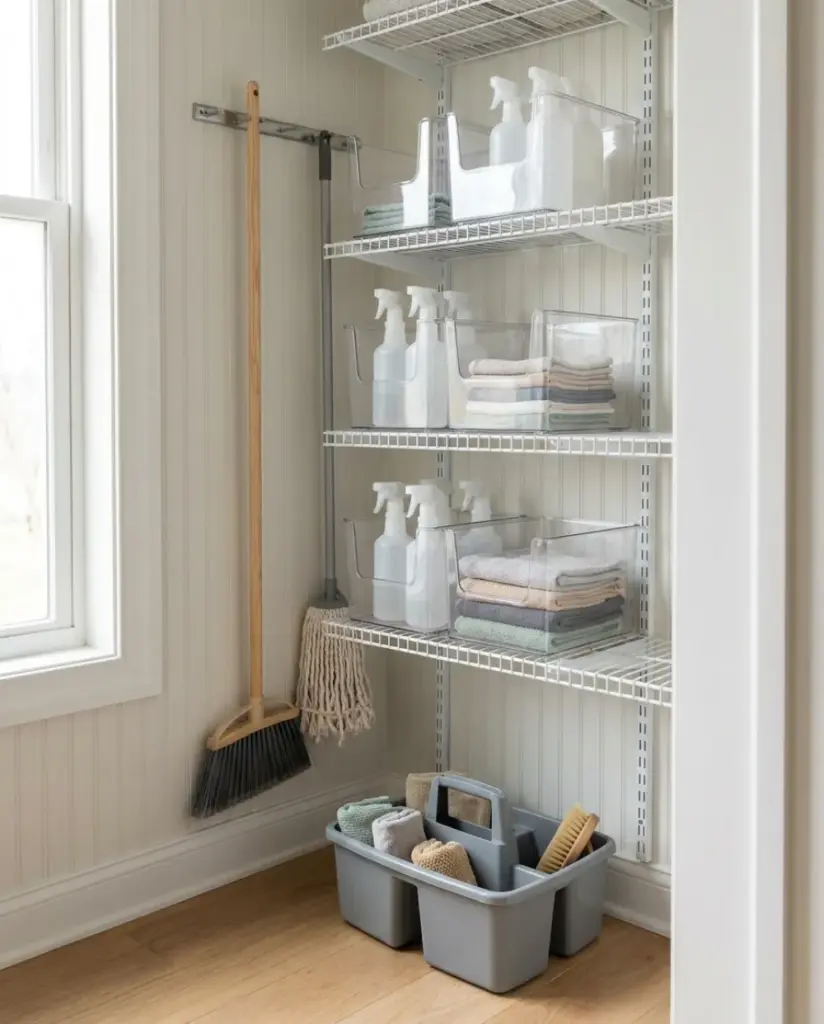
Contain loose bottles in clear, open-front bins so nothing tips over in the back of a cabinet. Hang brooms and mops on a wall rail or door rack to keep bristles off the floor. Add plain labels to bins and shelf edges, the same habit that keeps kitchen cabinets and drawers organized, so everyone in the house puts supplies back in the same spot. The right container depends on the room, which is why location matters as much as the steps themselves.
Where should you store cleaning supplies?
The best place to store cleaning supplies is the room where you use them, with backstock cleaning supplies kept on one cool, dry, high shelf. Storing cleaning supplies by room cuts down on trips across the house and keeps each cabinet light enough to stay neat. Most homes store cleaning supplies in four or five spots:
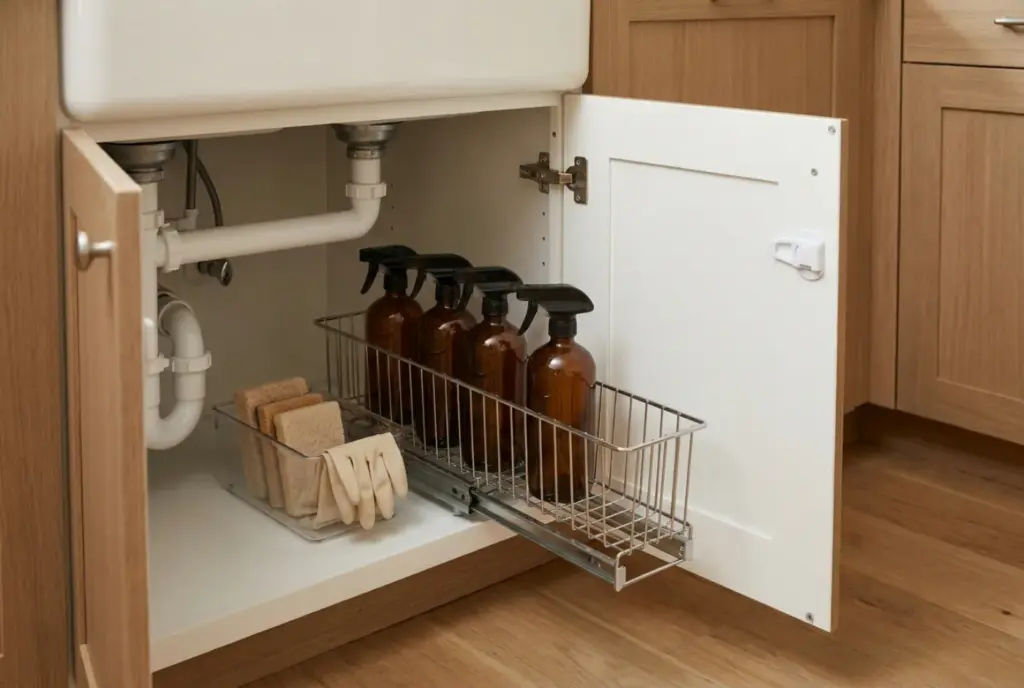
- Under the kitchen sink for dish and counter cleaning products, with a pull-out bin around the pipes
- In each bathroom vanity for that room’s toilet, tub, and mirror cleaning supplies
- In the laundry room for detergent, stain remover, and the drying rack
- In a hall or utility closet for the vacuum, mop, broom, and weekly caddy
- On a garage or basement shelf for sealed backstock, away from the furnace and water heater
The sink cabinet is the hardest of these to keep in order, and our guide to organizing under the kitchen sink covers the plumbing, leaks, and bin sizes in detail. Products you store in a garage should stay out of freezing winters and hot summers, since temperature swings can split bottles.
Extra paper towels and trash bags can live with backstock, so one shelf holds every refill in the house.
Which cleaning products should never be stored together?
Bleach should never be stored with, or mixed with, ammonia, vinegar, or other acidic cleaners, because the combinations release toxic gases. The EPA’s household hazardous waste guidance warns that incompatible products can react, ignite, or explode, and it advises keeping leftovers in their original containers with labels intact. Separate these groups on different shelves or in different bins:
- Chlorine bleach and products that list bleach or sodium hypochlorite
- Ammonia-based glass and surface cleaners
- Acidic cleaners, including vinegar, rust removers, and many toilet bowl cleaners
- Drain openers, oven cleaners, and other heavy-duty products
- Flammable aerosols and solvents, kept away from heat and pilot lights
How do you get rid of old cleaning chemicals?
You get rid of old cleaning chemicals by taking them to a household hazardous waste collection site or event, not by pouring them down the drain. Old pesticides, paint thinners, drain openers, and unlabeled bottles all count as household hazardous waste. Madison County and St. Clair County residents can check their county’s recycling office for collection dates. Keeping these groups apart also makes the next safety step much simpler.
How do you keep cleaning supplies safe from kids and pets?
You keep cleaning supplies safe from kids and pets by storing them up high or behind a lock, in their original child-resistant containers. The Consumer Product Safety Commission’s poison prevention guidance recommends a locked cabinet or box for household chemicals and says laundry packets should stay in their original container, out of a child’s sight and reach. Practical ways to follow that advice:
- Install a magnetic or spring latch on the sink cabinet
- Move laundry packets and dishwasher pods to a high shelf
- Keep the caddy on a closet shelf, not on the floor
- Return every bottle to its zone right after use
Pets need the same rules. A dog that can nose open a low cabinet can reach a toilet bowl tablet just as easily as a toddler can. Safe storage works in a small home too, as long as you build up instead of out.
How do you organize cleaning supplies in a small space?
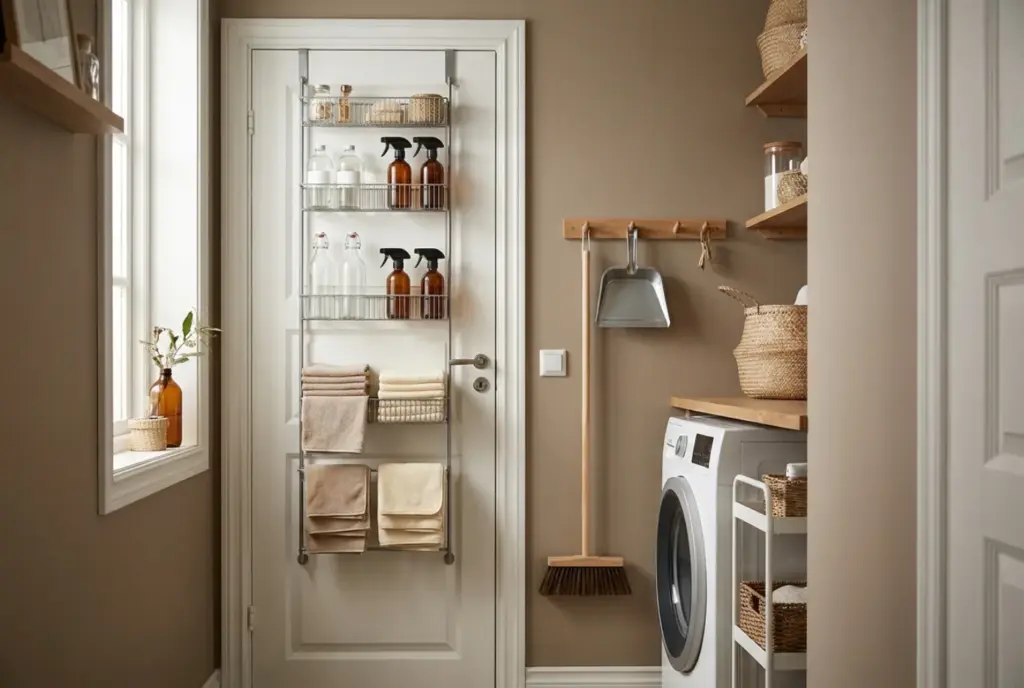
You organize cleaning supplies in a small space by using vertical storage: door racks, wall rails, and stacked or tiered bins. Apartments and smaller homes may have one shallow closet or none at all, so the walls and doors have to do the work. Options that hold up well:
- An over-the-door rack with deep baskets for sprays and cloths
- A wall-mounted rail with grip clips for the broom, mop, and duster
- A turntable in a deep corner cabinet
- A slim rolling cart that fits beside the washer or fridge
- A tension rod under the sink to hang spray bottles by their triggers
Laundry rooms often double as cleaning closets in smaller homes. Our guide on how to organize a laundry room shows how to fit both on the same wall without losing folding space.
How does a professional organizer set up a cleaning supply system?
A professional organizer sets up a cleaning supply system by working through every storage spot in the house in one session, then shopping for containers that fit the measured space. Kalli Erwin and the Just Right team, based in Alton and working in homes across Troy and the Metro East, follow the same order outlined above: gather, sort, edit, zone, and contain. The difference is speed and a second set of eyes on what you actually use.
Clients buy recommended bins and racks themselves, using the product research and shopping links Kalli provides. Donation haul-away is included with each session, so usable extras leave the house the same day. A cleaning closet also fits easily into a kitchen or laundry project. If you are weighing whether outside help makes sense, our breakdown of whether hiring a professional organizer is worth it walks through what to consider.
Frequently asked questions
What is the best way to store cleaning supplies?
The best way to store cleaning supplies is by task and room: daily products at waist height where you use them, weekly tools in a hall closet, and backstock on a high shelf. Keep every product in its original labeled container.
Where should you keep bathroom cleaning supplies?
Keep bathroom cleaning supplies in that bathroom's vanity or a wall cabinet, contained in one bin or caddy. If young children live in the home, add a cabinet latch or move the bin to a high shelf.
Is it safe to store cleaning supplies under the kitchen sink?
Storing cleaning supplies under the kitchen sink is safe when the cabinet has a child safety latch and products stay in their original containers. Use a waterproof tray or bin in case the pipes leak.
What should go in a cleaning caddy?
A cleaning caddy should hold a multi-surface spray, a glass cleaner, microfiber cloths, a scrub brush, a non-scratch sponge, and rubber gloves. Keep only the products you use every week so the caddy stays light.
How often should you go through your cleaning supplies?
Go through your cleaning supplies about twice a year, such as each spring and fall. Combine duplicates, recycle empty bottles, and take old chemicals to a household hazardous waste collection.
Want a cleaning closet that stays put together?
A cleaning supply system works best when it fits the way your household actually cleans. Kalli Erwin and the Just Right team set up practical, labeled zones for kitchens, laundry rooms, and closets across the Metro East, with donation haul-away included. Request a free organizing consultation to talk through your space.
Articles are researched and drafted with AI-assisted tools, illustrated with AI-generated images, and reviewed by Kalli Erwin before publishing.