
What is the best way to organize a junk drawer?
The best way to organize a junk drawer is to empty it, sort every item into keep, relocate, donate and recycle piles, and give each category its own compartment with drawer dividers. A junk drawer is simply a utility drawer without a system, so the fix is structure, not a bigger drawer. The method follows six steps:
- Empty the junk drawer completely.
- Sort everything into four piles.
- Test what you plan to keep.
- Measure the drawer and choose dividers.
- Give each category its own compartment.
- Put the most-used items in front.
Most kitchens have one drawer like this, which is why it comes up in nearly every kitchen organizing project we take on.
1. Empty the junk drawer completely
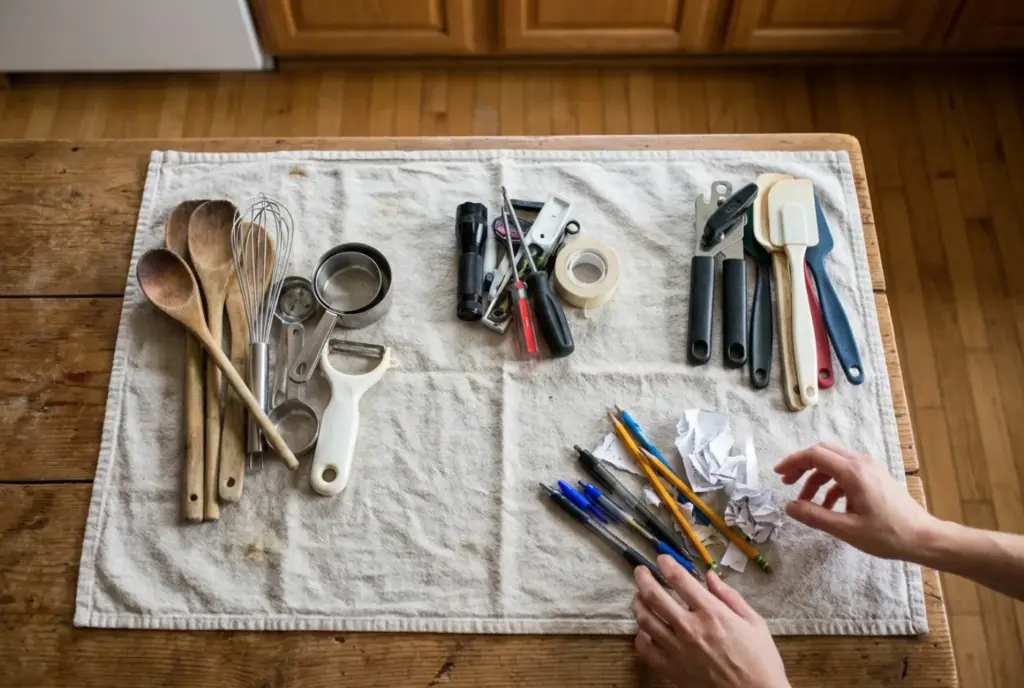
Emptying the junk drawer completely is the first step because small items hide in the back corners and under loose papers. Dump everything onto a towel on the counter or table.
- Pull the drawer out fully, or remove it, so nothing stays stuck in the back.
- Shake out crumbs and wipe the inside.
- Spread the contents in a single layer so you can see each item.
Seeing everything at once usually explains why the drawer never closes. Five pairs of scissors and a dozen takeout menus become obvious on a flat surface. Set a timer for 30 minutes if the job feels big; a single junk drawer rarely takes longer than that from start to finish.
2. Sort the junk drawer into four piles
Sorting the junk drawer into four piles decides what stays in the junk drawer and what leaves the kitchen for good. Give each item about five seconds, because the first instinct is usually right.
- Keep: daily-use tools such as scissors, tape, pens and a flashlight.
- Relocate: items that belong in another room, such as stray toys, tools or mail.
- Donate: duplicates in good condition, such as extra scissors or unused notepads.
- Recycle or toss: dead pens, expired coupons, old receipts and broken gadgets.
Batteries and old electronics need their own path out of the house. The EPA recommends that you tape lithium battery terminals or bag each battery separately before recycling, because loose batteries can spark and start fires.
Old phones and tangled chargers count too. The EPA’s page on electronics donation and recycling lists takeback and collection options, so those cords do not have to go back in the drawer.
3. Test what you plan to keep in the junk drawer
Testing what you plan to keep in the junk drawer removes the items that look useful but no longer work. A quick test takes ten minutes and saves a lot of frustration later.
- Scribble with every pen and marker.
- Check batteries with a tester or a device.
- Click every flashlight and lighter.
- Try every key in its lock, and recycle the ones that fit nothing.
Keep only one or two of each tool. A single good pair of scissors beats four dull ones, and the drawer stays lighter.
4. Measure the junk drawer and choose dividers
Measuring the junk drawer before you buy dividers ensures every organizer fits with no wasted gaps. Record the inside width, depth and height.
Adjustable drawer dividers
Spring-loaded or expandable dividers split a deep drawer into long lanes. They suit kitchens where the drawer holds larger tools.
Modular bins
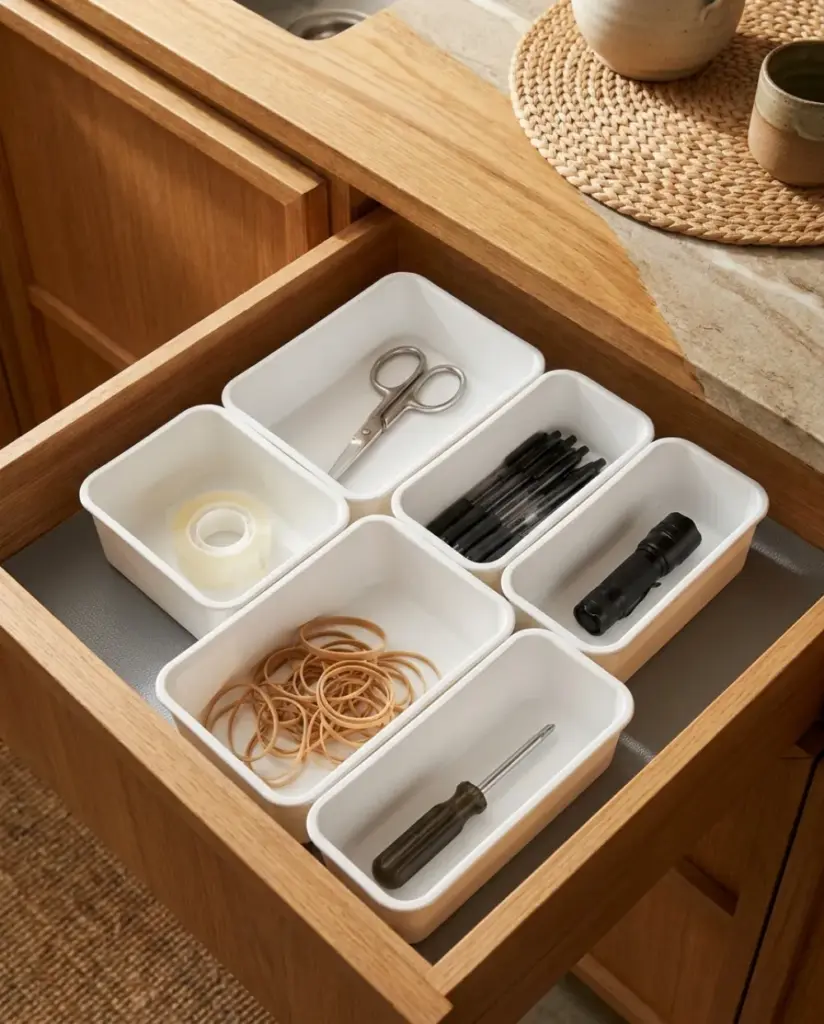
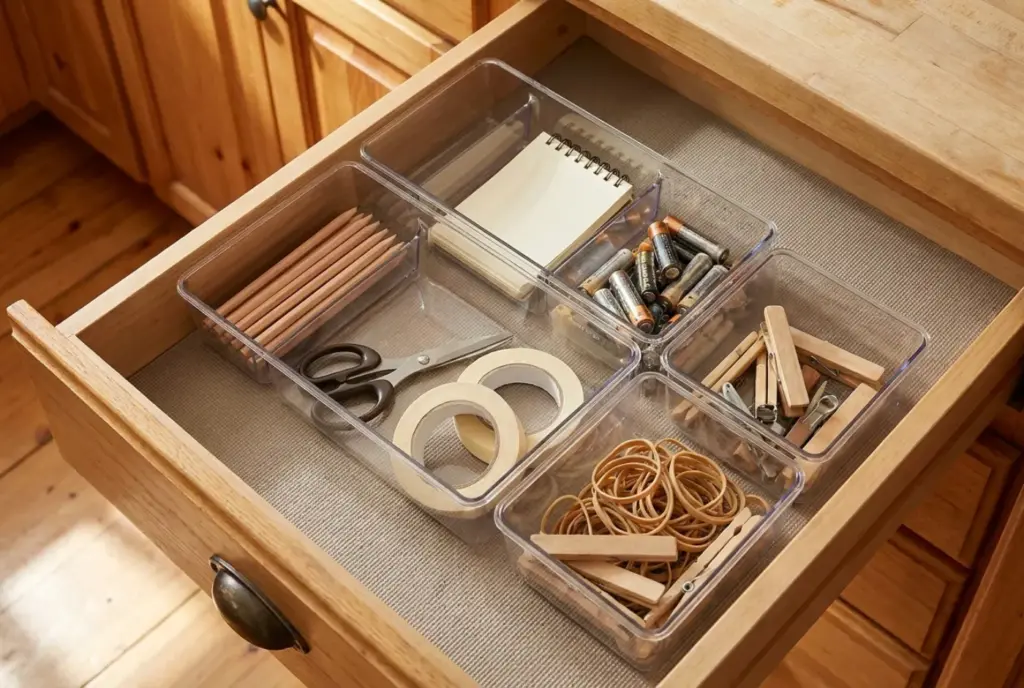
Small rectangular bins in mixed sizes fit together like a puzzle. They work best in shallow drawers full of small items.
Non-slip liner
A thin liner under the bins stops them from sliding when you open the drawer.
Lay the bins out on the counter first to test the arrangement. Our guide on how to organize kitchen cabinets and drawers uses the same measure-first approach for every other drawer in the room.
5. Give each junk drawer category its own compartment
Giving each junk drawer category its own compartment keeps the junk drawer organized after the first week. When every item in the junk drawer has a named spot, putting it back takes no thought.
- Writing: pens, a pencil, a marker and a small notepad.
- Cutting and sealing: scissors, tape and a box cutter.
- Fixing: a small screwdriver, picture hooks and a tape measure.
- Power: spare batteries, sorted by size.
- Small stuff: rubber bands, twist ties and a few chip clips.
- First aid: a few bandages and pain-relief packets.
Keys are better on a hook by the door than in a drawer, and our guide on how to organize an entryway shows how to set up that landing spot.
6. Put the most-used junk drawer items in front
Putting the most-used junk drawer items in front means you open the drawer, grab what you need and close it without digging. Store backups and once-a-month tools at the back.
- Front: pens, scissors, tape.
- Middle: batteries, chip clips, rubber bands.
- Back: spare keys, manuals you still need, the tape measure.
Once the layout matches your habits, the drawer only needs a quick reset now and then.
What if you have more than one junk drawer?
More than one junk drawer is fine when each one has a clear theme. A kitchen utility drawer, a small tool drawer in the garage and a stationery drawer by the desk each stay manageable because nothing overlaps. Stationery, chargers and envelopes usually belong with the rest of the desk setup, and our guide on how to organize a home office covers where those live.
The test for any second drawer is simple. If you cannot name its theme in two words, it is turning back into a catch-all.
What should go in a junk drawer?
A junk drawer should hold the small, frequently used household tools that have no other home: pens, scissors, tape, batteries, a flashlight and a few basic repair tools. Everything in a junk drawer should earn its spot through weekly use, and calling it a utility drawer helps set that limit.
- Pens, a marker and a notepad.
- Scissors and clear packing tape.
- A small screwdriver or multi-tool.
- A flashlight and spare batteries.
- Rubber bands, twist ties and chip clips.
Paper does not belong here. Warranties, receipts and manuals belong in a simple home filing system, which our guide on how to organize paperwork at home sets up step by step.
Where should you keep button batteries in a junk drawer?
Button batteries should be kept out of the junk drawer entirely in homes with young children, in a sealed container on a high shelf. Coin-sized lithium batteries are easy for small children to swallow and can cause serious injury.
The National Capital Poison Center reports that more than 3,500 people in the United States swallow button batteries every year. If someone swallows one, call the National Battery Ingestion Hotline at 1-800-498-8666 right away.
- Keep button batteries in their original packaging.
- Store the package up high, away from the utility drawer.
- Recycle used button batteries promptly instead of collecting them.
How do professional organizers handle a junk drawer?
Professional organizers handle a junk drawer as a symptom, because a drawer overflows when other parts of the house lack a home for things. Fixing the drawer usually means fixing the spaces around it.
- We trace each stray item back to the room where it belongs.
- We set up homes for keys, mail and paper outside the kitchen.
- We recommend dividers that fit the measurements, and clients buy only what the plan needs.
- We take donations with us at the end of the session.
The team works across the Metro East, and our page on professional organizing in Edwardsville, IL covers the area close to our Alton base.
Frequently asked questions
What do you keep in your junk drawer?
Keep small household tools you use every week in your junk drawer: pens, scissors, tape, a flashlight, spare batteries, rubber bands and a small screwdriver. Paper, keys and anything that belongs in another room should live somewhere else.
Is it okay to have a junk drawer?
Yes, a junk drawer is fine as long as it has limits and compartments. One utility drawer near the kitchen keeps everyday tools handy and stops small items from spreading across the counters.
How often should you reorganize a junk drawer?
Reset a junk drawer for five minutes about once a month and do a full empty-and-sort a couple of times a year. A quick monthly pass catches dead pens and stray paper before they pile up.
What do you use to divide a junk drawer?
Adjustable drawer dividers, modular bins in mixed sizes and a thin non-slip liner are the most useful tools for dividing a junk drawer. Measure the inside of the drawer first so the bins fit without gaps.
Want help with the drawers that never close?
Kalli Erwin and the Just Right team set up kitchens where every drawer has a job, and the rest of the house has homes for what used to land there. We research organizers, send you shopping links and haul away donations at the end of each session. Request a free organizing consultation to get started.
Articles are researched and drafted with AI-assisted tools, illustrated with AI-generated images, and reviewed by Kalli Erwin before publishing.