
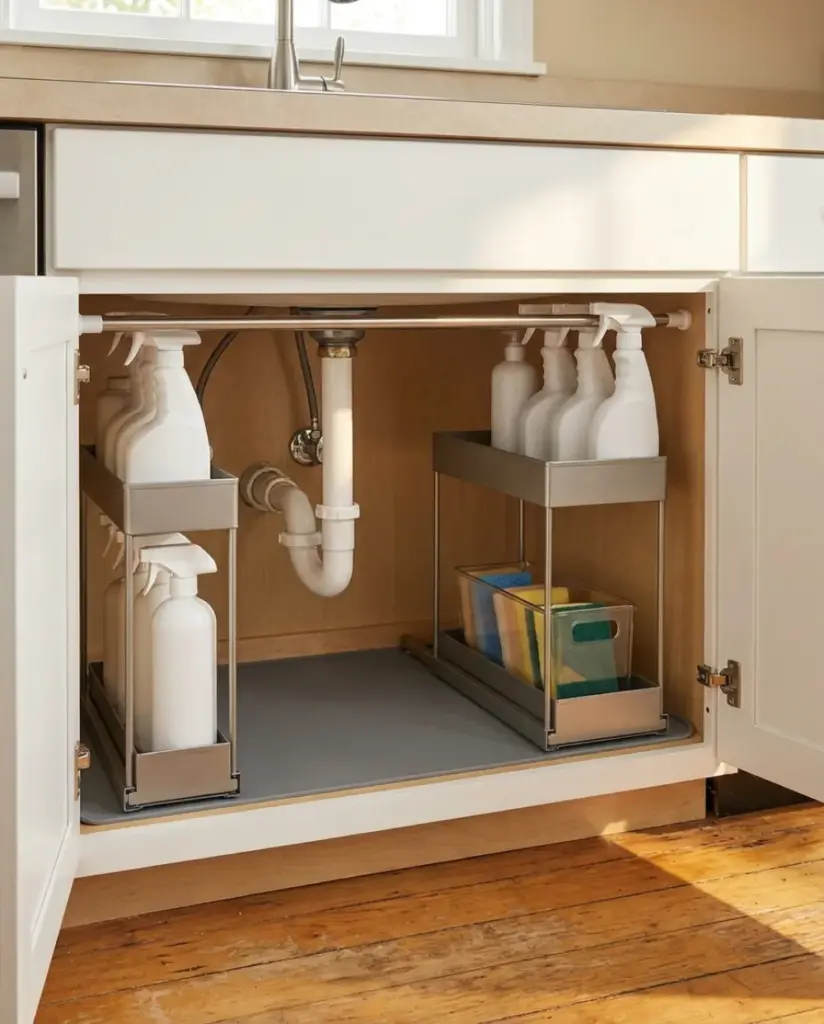
What is the best way to organize under the kitchen sink?
The best way to organize under the kitchen sink is to empty the cabinet, protect the floor from leaks, and fit organizers around the pipes so every item sits in a group you can see. The cabinet under the kitchen sink is awkward because the drain, the water lines and sometimes a garbage disposal take up the middle. The method follows six steps:
- Empty the cabinet and check for leaks.
- Sort what you find under the kitchen sink.
- Line the cabinet floor under the sink.
- Fit organizers around the pipes.
- Use the sink cabinet doors and the space above the bins.
- Group what remains by task.
The same order applies whether the cabinet holds three bottles or thirty. It is one of the first spaces we tackle in a kitchen organizing session because it touches dishes, cleaning and trash every day.
1. Empty the cabinet under the kitchen sink and check for leaks
Emptying the cabinet under the kitchen sink is the first step because you need to see the plumbing and the cabinet floor before you plan storage around them. Pull every bottle, sponge and bag out onto a towel.
- Look for water stains, soft or warped wood and a musty smell.
- Run the faucet and the dishwasher, then check the drain joints and supply lines for drips.
- Wipe the cabinet floor and walls and let them dry with the door open.
Small drips add up fast. The EPA’s WaterSense program estimates that the average household’s leaks waste more than 9,300 gallons of water every year, and a leak under the sink often goes unnoticed behind a wall of bottles. Call a plumber for any active leak before you put anything back.
2. Sort what you find under the kitchen sink
Sorting what you find under the kitchen sink decides what stays under the sink, what moves to another room and what needs safe disposal. Most kitchen sink cabinets hold far more than the kitchen actually uses, often three or four half-empty bottles of the same cleaner.
- Keep: the dish soap refill, dishwasher detergent, one all-purpose cleaner, sponges and trash bags.
- Relocate: bathroom cleaners, car products, extra paper towels and bulk backups.
- Dispose: empty bottles, dried-out sponges and products you no longer use.
Old cleaners and chemicals need care when they leave the house. The EPA notes that household hazardous waste such as cleaners, oils and pesticides should not be poured down the drain, so set those aside for your county’s collection day. Bulk backups often fit better on a garage shelf, and our guide on how to organize a garage covers where they can live.
3. Line the cabinet floor under the kitchen sink
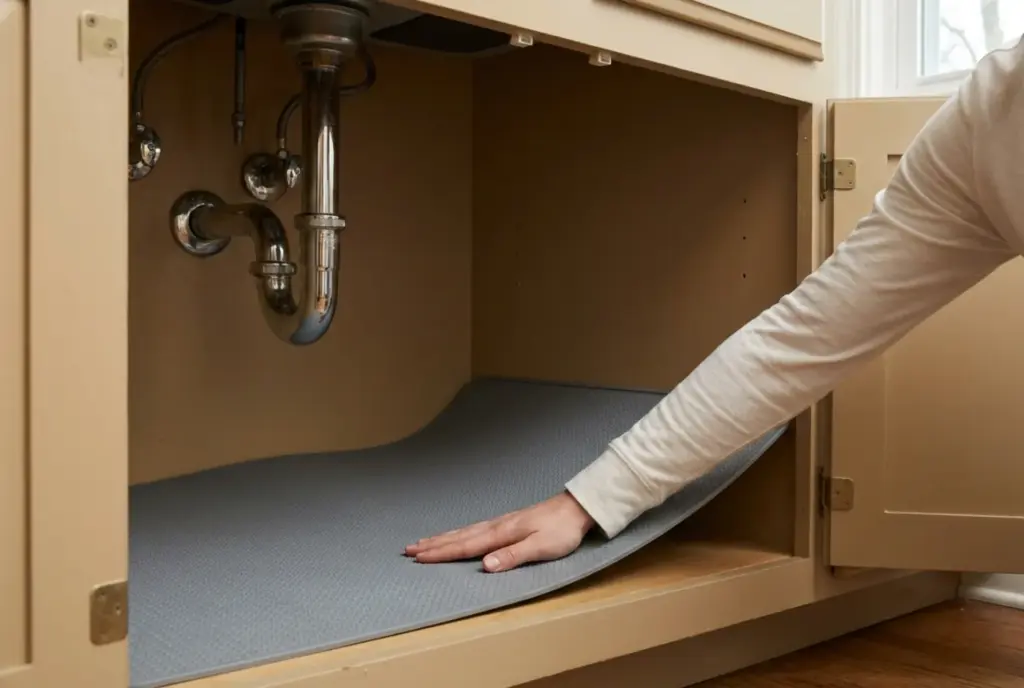
Lining the cabinet floor under the kitchen sink protects the wood from sink leaks and drips and makes the space under the sink easy to wipe. A waterproof under-sink mat with a raised edge holds a small spill until you notice it.
- Choose a silicone or rubber mat that is cut to size or trimmable.
- Avoid paper or felt liners that hold moisture against the wood.
- Check the mat whenever you restock so a slow drip never hides.
Moisture is the real enemy here. The EPA’s guide to mold and moisture says wet areas dried within 24 to 48 hours usually will not grow mold, which is why a liner you can see and dry quickly matters more than how it looks.
4. Fit organizers around the pipes under the kitchen sink
Fitting under-sink organizers around the pipes under the kitchen sink turns the dead space beside the drain into usable kitchen sink storage. Measure the cabinet width, depth and the height to the lowest pipe before you shop.
Two-tier sliding shelves
Narrow pull-out shelves sit on each side of the drain and double the storage height. They work well for sprays and bottles you use daily.
U-shaped or adjustable shelves
Expandable shelves straddle the drain and the disposal. They suit wide cabinets where the pipes sit in the center.
Stackable clear drawers
Small drawers hold dishwasher pods, sponges and scrub brushes. Clear sides let you see what is running low.
Whatever style you choose, leave a few inches open around the shutoff valves so you can reach them in an emergency. We research the options for each cabinet and send clients shopping links, so they buy only the pieces that fit the measurements.
5. Use the sink cabinet doors and the space above the bins
Using the sink cabinet doors and the space above the bins adds storage under the kitchen sink without crowding the cabinet floor. Spray bottles, gloves and lightweight kitchen sink tools are the best candidates.
- Install a tension rod near the top of the cabinet and hang spray bottles by their triggers.
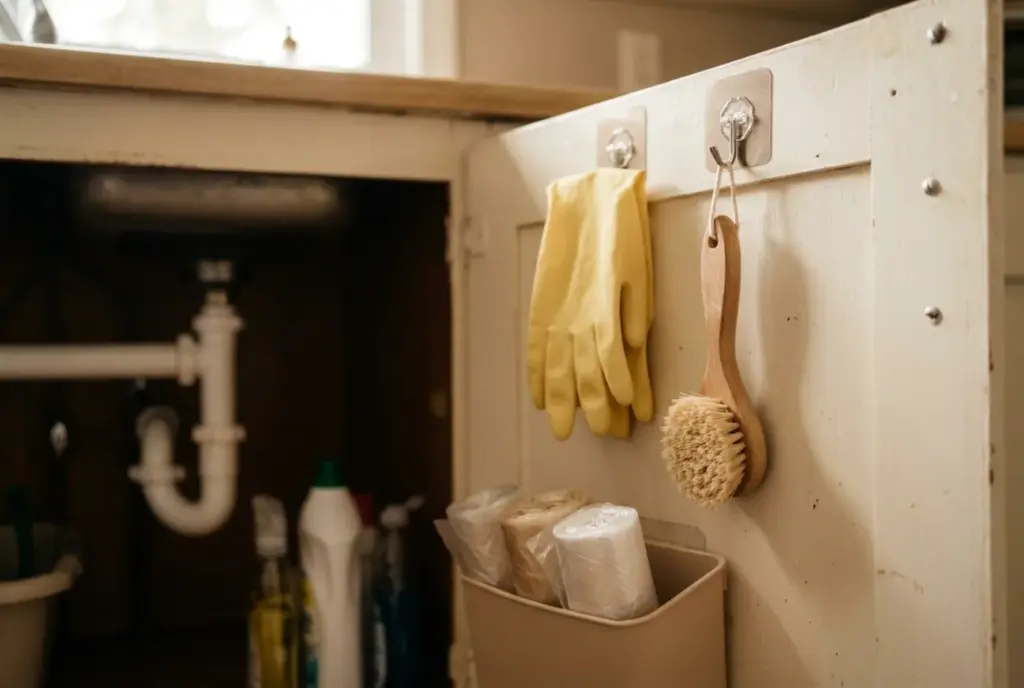
- Add adhesive hooks inside the door for gloves and a scrub brush.
- Mount a small bin on the door for trash bags or sponges.
- Leave clearance so the door still closes past the pipes.
Door storage keeps the items you grab most often within reach without bending down to dig. Check the weight limit on any adhesive hook, because a damp cabinet weakens some adhesives over time, and screw-in hooks hold better on solid wood doors.
6. Group what remains under the kitchen sink by task
Grouping what remains under the kitchen sink by task means each bin or shelf holds everything for one job. Task groups make restocking obvious.
- Dishwashing: dish soap refill, dishwasher pods, rinse aid.
- Cleaning: one all-purpose spray, a scrub brush, microfiber cloths.
- Trash: bags in the roll or box, ideally near the bin.
Keep the most-used group at the front and the backups behind it. When the counter above follows the same logic, our guide on how to organize kitchen counters shows how to keep dish soap and a brush in one caddy.
What should be kept under the kitchen sink?
The items that should be kept under the kitchen sink are the supplies you use at the sink every day: dish soap, dishwasher detergent, sponges, a basic cleaner and trash bags. Anything outside that list probably belongs somewhere else.
- Dish soap and its refill.
- Dishwasher pods or powder and rinse aid.
- Sponges, scrub brushes and microfiber cloths.
- One all-purpose cleaner and one glass cleaner.
- Trash and recycling bags.
Bathroom supplies follow the same rule in their own cabinet, and our guide on how to organize bathroom cabinets applies it to the other sink in the house.
What should not be stored under the kitchen sink?
Food, paper goods, flammable products and anything poisonous within a child’s reach should not be stored under the kitchen sink. The cabinet is damp, close to pipes and easy for small hands to open.
- Food and pet food: moisture and pests can reach it.
- Paper towels and napkins in bulk: they soak up any leak.
- Flammable products: keep them away from the dishwasher and disposal wiring.
- Strong chemicals in homes with young children: move them up high or lock the cabinet.
MedlinePlus, from the National Library of Medicine, advises that you keep dangerous products where children cannot reach them and call poison control at 1-800-222-1222 if you suspect a poisoning. A child safety latch on the sink cabinet is a simple layer of protection.
How do professional organizers set up the space under a sink?
Professional organizers set up the space under a sink by planning around the plumbing first and buying organizers last. The goal is a cabinet that a whole household can restock without thinking.
- We measure the cabinet and the pipe clearance before recommending anything.
- We edit duplicates so only one of each product stays.
- We set up task groups so refills always go back to the same spot.
- We take donations with us at the end of the session.
Families across the river towns call us for this kind of small but daily space, and our page on professional organizing in Alton, IL shows where our team works close to home.
Frequently asked questions
What can I put under my kitchen sink to organize it?
A waterproof mat, two-tier sliding shelves or a U-shaped shelf that fits around the pipes, clear stackable drawers and a tension rod for spray bottles cover most under-sink cabinets. Measure the height to the lowest pipe before buying any of them.
Should I keep cleaning products under the kitchen sink?
You can keep a small set of daily cleaning products under the kitchen sink if no young children live in or visit the home. With small children around, move cleaners to a high cabinet or add a safety latch to the sink cabinet.
How do you organize under a sink with a garbage disposal?
Use a U-shaped or adjustable shelf that straddles the disposal, or narrow sliding shelves on each side of it. Keep the area directly around the disposal unit and its wiring clear.
How often should you reorganize under the kitchen sink?
Reorganize under the kitchen sink about twice a year with a full empty-and-wipe, and glance at it each time you restock. Each check is a chance to spot a slow leak before it damages the cabinet floor.
Want help with the cabinet under your sink?
Kalli Erwin and the Just Right team set up kitchen storage that fits your plumbing, your routines and your household. We measure, research products, send shopping links and haul away donations at the end of each session. Request a free organizing consultation to start with a quick phone call.
Articles are researched and drafted with AI-assisted tools, illustrated with AI-generated images, and reviewed by Kalli Erwin before publishing.