
How do you organize jewelry?
To organize jewelry, gather every piece in one place, sort out what you no longer wear, group the rest by type, and give each type storage that keeps it separated, visible, and untangled. Necklaces hang or lie flat, earrings and rings go in divided trays, and delicate pieces get soft, separate pouches. The same steps work for a full jewelry box, a dresser drawer, or a closet wall, and they fit naturally into closet organizing, where most people get ready each morning.
- Gather all your jewelry in one place.
- Sort jewelry into keep, repair, and let-go piles.
- Group jewelry by type.
- Store necklaces and chains so they never tangle.
- Use divided trays for earrings and rings.
- Protect fine jewelry, pearls, and silver.
- Keep everyday jewelry where you get ready.
1. Gather all your jewelry in one place
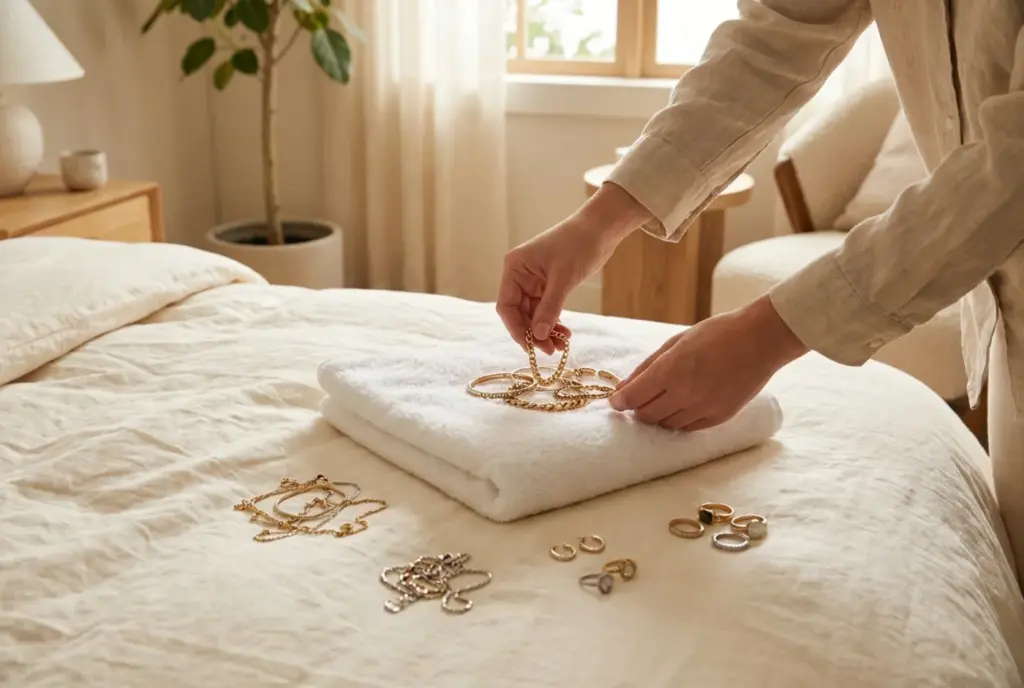
Gathering all your jewelry in one place shows you how much you own and which pieces have been hiding. Lay a towel on a bed or table so small pieces do not roll away.
- Check the jewelry box, dresser top, nightstand, and bathroom counter.
- Check coat pockets, purses, travel bags, and the car.
- Collect loose backs, clasps, and single earrings in a small dish.
Seeing the whole collection together often reveals matching earrings that were split up for years, plus duplicates you forgot you owned.
2. Sort jewelry into keep, repair, and let-go piles
Sorting jewelry into keep, repair, and let-go piles leaves only pieces you wear or treasure. Decide on each piece quickly:
- Keep: pieces you wore in the last year, plus heirlooms and sentimental items.
- Repair: broken clasps, missing stones, and knotted chains worth fixing; bag them together for one trip to a jeweler.
- Let go: costume pieces you never reach for, single earrings with no match, and items that irritate your skin.
Jewelry sorting often happens alongside a closet edit, and our guide on paring down your wardrobe uses the same keep or let-go questions for clothes.
3. Group jewelry by type
Grouping jewelry by type is what makes every storage choice easier, because each type needs a different kind of space. Make one pile for each:
- Necklaces and pendants.
- Earrings, studs and hoops kept apart.
- Rings.
- Bracelets, bangles, and cuffs.
- Watches.
- Fine jewelry, pearls, and heirlooms.
Count each pile before buying any organizer, since the count tells you how many hooks, slots, or compartments you need.
4. Store necklaces and chains so they never tangle
Store necklaces and chains hanging from individual hooks or lying flat in a divided tray so they never tangle. Necklace tangles start when chains touch and shift, so keeping each necklace separated is the goal.
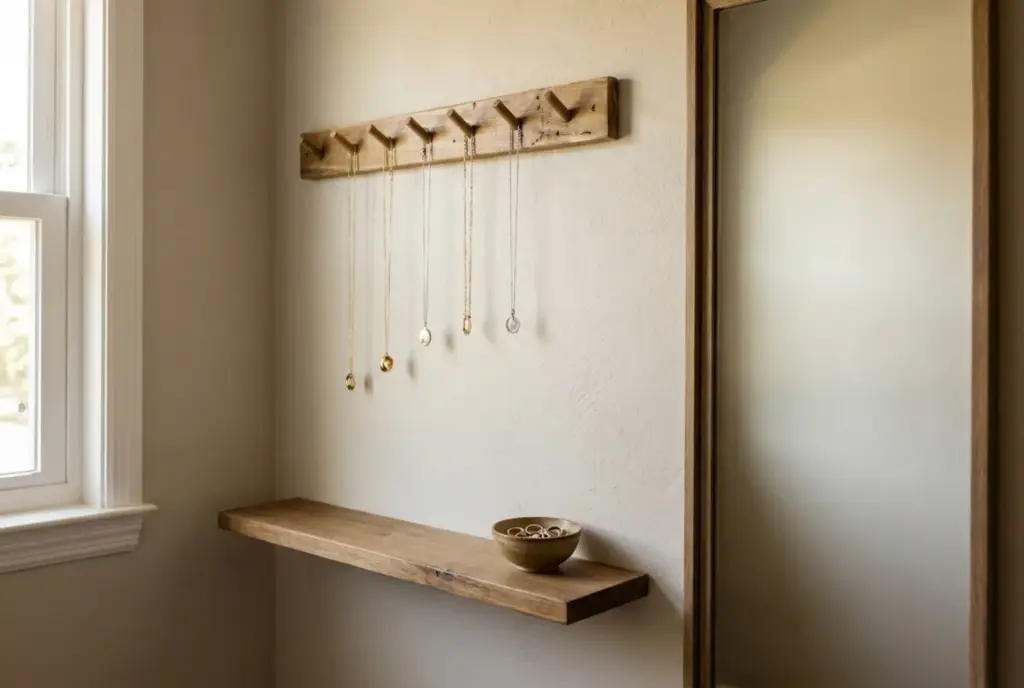
- Wall or door hooks: one necklace per hook, clasped closed.
- Hanging organizers: clear-pocket organizers on a closet hanger.
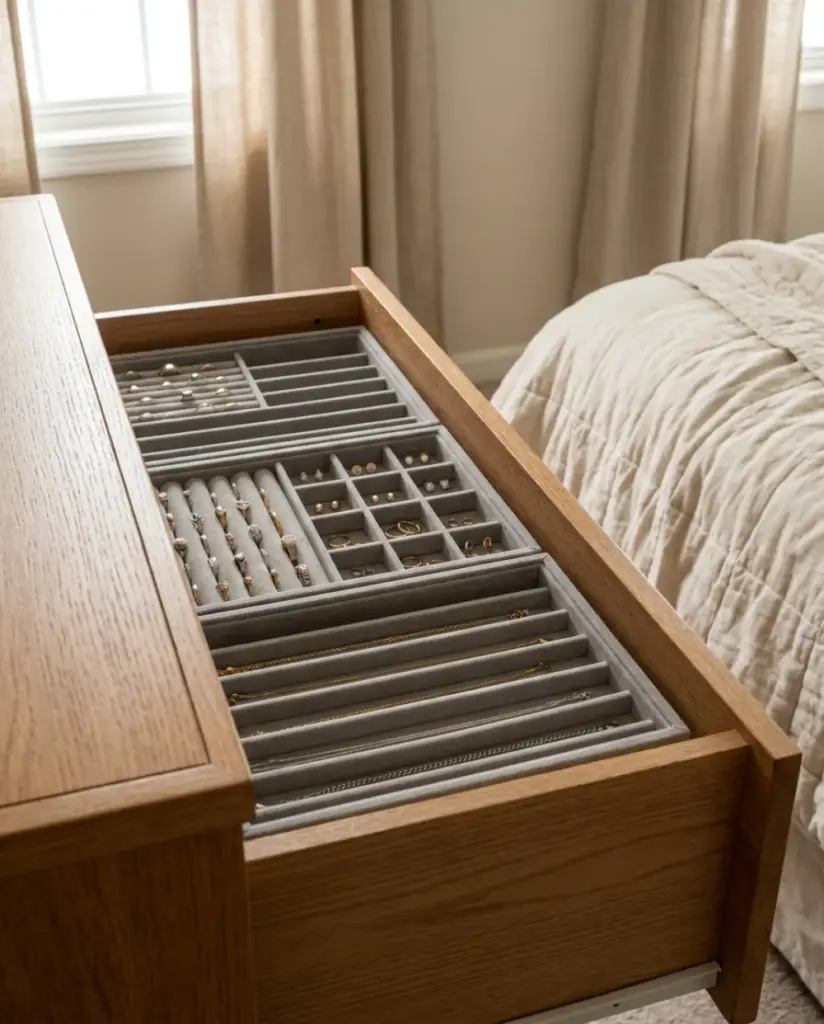
- Long divided trays: chains laid straight in their own channel in a drawer.
- Travel trick: thread a fine chain through a drinking straw and clasp it.
5. Use divided trays for earrings and rings
Divided trays keep earrings and rings in pairs and in sight. Lined compartments stop metal from scratching metal and make a missing earring obvious.
- Stackable lined trays in a dresser drawer for studs, hoops, and rings.
- Ring rolls or slotted ring trays for rings.
- Small pill organizers or ice cube trays as budget dividers.
- A pierced card or mesh panel for dangle earrings.
Choose shallow trays, since jewelry stacked in deep bins ends up buried.
6. Protect fine jewelry, pearls, and silver
Fine jewelry, pearls, and silver need separate, soft storage so harder pieces cannot scratch softer ones. According to the Gemological Institute of America, pearl ranks just 2.5 on the Mohs hardness scale, which means it scratches easily.
- Keep pearls apart from other jewelry in a soft pouch or lined case.
- Store each fine piece in its own compartment or pouch.
- Keep silver in a closed box or pouch with an anti-tarnish strip.
- Avoid storing jewelry in a steamy bathroom.
The GIA also advises wiping pearls after wear, storing them in a soft pouch or case, and keeping them out of dry, hot environments.
Heirloom pieces deserve the same care plus a short note about their history, kept in the pouch or box, so the story stays with the jewelry when it is passed down.
7. Keep everyday jewelry where you get ready
Keep everyday jewelry in one small spot where you get ready, so the pieces you wear daily never travel around the house. A dish on the dresser or a single tray in the top drawer is enough.
- Limit the everyday spot to five to ten pieces.
- Return pieces there at night instead of the nightstand or sink.
- Rotate seasonal pieces in and out a few times a year.
A small dressing area makes this easier; our guide on how to organize a small bedroom shows where a jewelry station can fit.
How do you store bracelets and watches?
Store bracelets and watches flat or on a raised bar so clasps and faces do not rub against other pieces. Bangles and cuffs need wider space than rings, and watches need a soft surface.
- Bangles and cuffs: a wide lined tray compartment, or stacked on a short bracelet bar.
- Chain bracelets: clasped and laid straight, like a short necklace.
- Watches: a cushioned watch tray or pillow slots, face up.
- Charm bracelets: their own pouch, since charms catch on everything nearby.
How do you organize jewelry without a jewelry box?
To organize jewelry without a jewelry box, use a dresser drawer with divided trays, wall hooks, or a hanging organizer in the closet. Each works because it separates pieces and keeps them visible.
- Dresser drawer: lined trays by type, necklaces in the longest channel.
- Closet wall: a peg rail or hooks beside the mirror.
- Closet hanger: a pocketed organizer that hangs with your clothes.
- Shadow box or framed panel: earrings and necklaces displayed like art.
Our guide on how to organize a closet covers how to fit a jewelry zone among shelves and rods.
Where is the safest place to store jewelry at home?
The safest place to store valuable jewelry at home is a locked, out-of-sight spot, backed by a written inventory with photos. The Insurance Information Institute recommends listing jewelry in a home inventory, photographing items, and checking your policy’s special limits for jewelry, since a separate floater may be needed for high-value pieces.
- Photograph each valuable piece and save receipts or appraisals.
- Keep the inventory somewhere other than the house, such as cloud storage.
- Keep only everyday pieces out in the open.
How does jewelry fit into closet and dressing area organizing?
Jewelry is usually one zone in a larger closet and dressing area plan, next to accessories, scarves, and belts. Kalli Erwin and the Just Right Organizing team implement functional systems in closets and bedrooms across Alton, Troy, Edwardsville, and the Illinois Metro East.
- We sort and group jewelry and accessories with you during closet sessions.
- Kalli researches trays, hooks, and organizers and shares shopping links, and you buy what you like.
- Donation haul-away is included each session for pieces you decide to let go.
Our real organizing projects show how small zones like this fit into finished closets and bedrooms.
Frequently asked questions
Is it okay to store jewelry in ziploc bags?
Yes, small zip bags are okay for costume jewelry and for travel, since they keep pieces separated. Pearls and delicate gems are better in a soft pouch or lined case, which the GIA recommends for pearls.
How do you organize a lot of jewelry?
Organize a lot of jewelry by sorting it first, then giving each type its own storage, such as stacked drawer trays for earrings and rings and hooks for necklaces. Keep only everyday pieces out and store the rest by type.
How do you keep silver jewelry from tarnishing?
Keep silver jewelry in a closed pouch or box with an anti-tarnish strip, away from bathroom humidity. Wipe pieces with a soft cloth after wearing before you put them away.
How do you store earrings so pairs stay together?
Store earrings in a divided tray with one pair per compartment, or push studs through a pierced card. Pairs stay together because each one has a fixed home.
Should you keep jewelry in the bathroom?
No, jewelry is better stored outside the bathroom, where steam and humidity can dull finishes and pieces can slip down the drain. A dresser or closet spot is a safer choice.
Want a dressing area that keeps everything in its place?
Jewelry is often the small detail that makes a closet feel finished. If you would like hands-on help with your closet, jewelry, and accessories, request a free organizing consultation and we will talk through your space by phone. Packages start at $850.
Articles are researched and drafted with AI-assisted tools, illustrated with AI-generated images, and reviewed by Kalli Erwin before publishing.