
How to declutter clothes in 7 steps
Reduce your clothes by category, let go of clothes that fail the fit and wear test, and donate those clothes the same day.
The full process takes one to three sessions of two to three hours for a typical bedroom closet and dresser. The seven steps below keep each session short enough to finish.
1. Pick one category and one time block
Start with a single category such as tops, jeans, or workout clothes. Block two to three hours on a calendar and stop when the timer ends. A small, finished category builds momentum that a half-emptied closet never will.
2. Pull every piece into one pile
Gather that category from every spot it hides: the closet, dresser, laundry basket, guest room, and storage bins. Lay it all on the bed. Seeing twelve black T-shirts in one place makes duplicates obvious in a way that scattered drawers hide.
3. Ask the fit, wear, and love questions
Hold each item and answer three questions honestly:
- Fit: Does it fit my body today, not a past or future size?
- Wear: Have I worn it in the last year, through every season?
- Love: Do I feel good in it without tugging, pinning, or special care I never give?
An item that fails two of the three questions is a strong candidate to leave.
4. Sort into keep, donate, sell, and toss
Set out four bags or bins before you begin so every decision has a landing spot:
- Keep: fits, gets worn, and earns its hanger.
- Donate: clean and wearable, but not right for you.
- Sell: higher value pieces worth the effort of listing.
- Toss or recycle: stained, torn, stretched, or worn thin.
5. Box the maybes with a date
Put items you cannot decide on into one box, write a date three to six months out on it, and store it out of sight. If you never open the box before that date, donate it without reopening it.
6. Get donations out the same day
Load donation bags into your car right away. Bags that sit in a hallway get reopened, and pieces drift back into drawers.
7. Put the keepers back by category
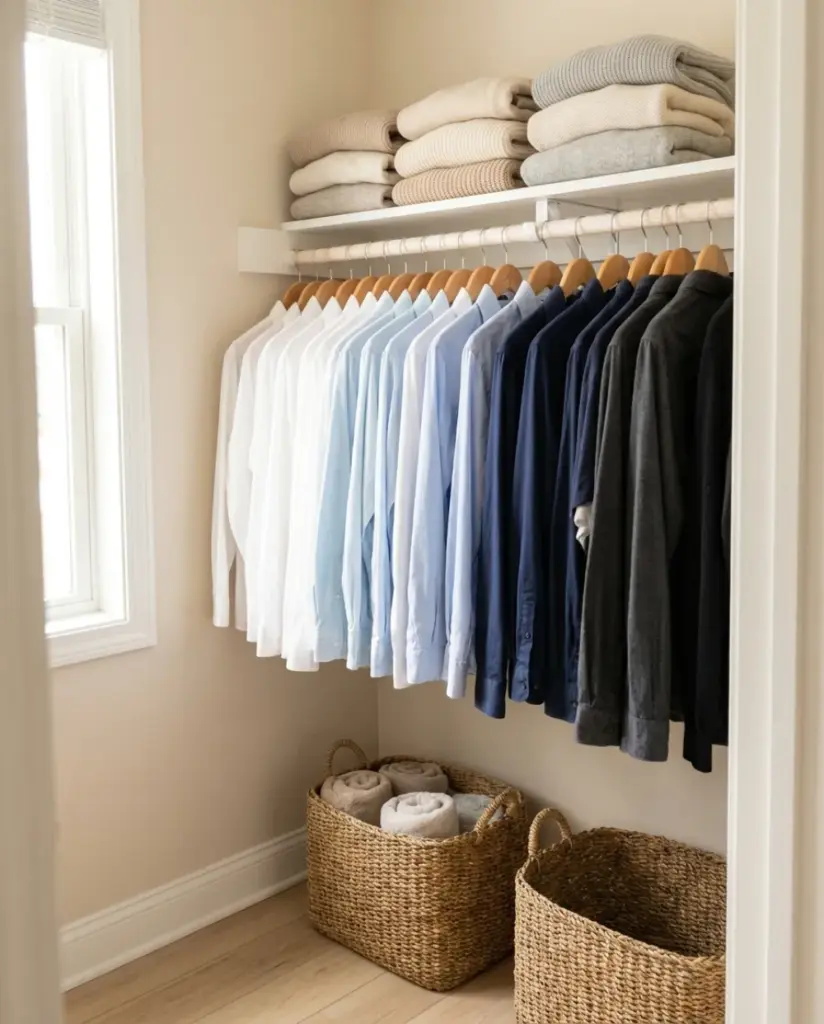
Return what stays grouped by type and then by color, with everyday pieces at eye level and occasion wear to the side. Our guide to organizing a closet covers hanger, shelf, and bin choices once the edit is done, and that sorted closet makes the keep or let go rules much easier to apply.
What rules help you decide which clothes to keep?
The rules that help you decide which clothes to keep are time tests: if you have not worn a piece of clothing in a set window, it goes. Rules make clothing decisions faster because they replace “maybe someday” with a clear yes or no. Pick one or two of the four rules below and apply them to every piece of clothing in the pile.
The 90/90 rule
If you have not worn an item in the last 90 days and will not wear it in the next 90, let it go. Run this rule at each change of season so it covers the full year.
The one year rule
Anything that went a full year of seasons without being worn leaves. Special occasion pieces, like a suit for funerals or a winter coat for rare cold snaps, are the fair exceptions.
The hanger trick
Turn every hanger backward. Flip a hanger forward only after you wear that piece. After six months, the backward hangers show you exactly what you skip.
One in, one out
Each new piece that comes home sends one similar piece out. This rule does the most good after a big sort because it protects the space you just made, which matters more once you know where the outgoing pieces will go.
What should you do with clothes you no longer want?
Clothes you no longer want should be donated, sold, given away, or recycled, in that order, so the fewest unwanted clothes end up in a landfill. The U.S. Environmental Protection Agency estimates that landfills received 11.3 million tons of textiles in 2018, out of 17 million tons generated that year. Sending wearable pieces back into use is the simplest way to keep your closet edit from adding to that number.
- Donate: clean, wearable clothes you no longer want to a thrift store, church closet, or shelter.
- Sell: designer, nearly new, or specialty items through consignment.
- Give: kids’ clothes and outerwear to friends, family, or school clothing drives.
- Recycle: worn out clothes through a textile recycling drop off or rag bin.
If you plan to claim a tax deduction, keep a simple list of what you gave. The IRS states in Publication 526 on charitable contributions that donated clothing must be in good used condition or better to qualify. That rule is a useful filter on its own: if a piece is not good enough to donate, it belongs in the recycle bag. Our full guide to sorting your whole home uses the same donate first approach for every room.
What are the biggest mistakes when sorting clothes?
The biggest mistake when sorting clothes is starting with the whole closet at once instead of one category. A full closet dumped on the bed at 8 p.m. usually goes back in unsorted. These other mistakes stall progress almost as often:
- Keeping “goal size” clothes that have not fit in years.
- Saving pieces only because they were expensive.
- Starting with sentimental items like a wedding dress or a late parent’s sweater.
- Buying bins and organizers before you know what stays.
- Letting donation bags sit in the house for weeks.
- Sorting a family member’s clothes without them.
Sentimental pieces deserve their own session at the end. Choose one or two items to keep and display, and photograph the rest before they go. Shoes follow the same rules, and our roundup of shoe storage ideas helps once the pairs you kept need a home. Avoiding these mistakes gets the closet clear once; keeping it that way takes a few small habits.
How do you keep your closet from filling back up?
You keep your closet from filling back up by giving your clothes a limit and checking that limit on a schedule. A fixed number of hangers is the easiest closet limit to see: when the rod is full, one piece of clothing has to leave before a new one comes in.
- Keep a donation bag on the closet floor at all times.
- Do a 15 minute check at each change of season.
- Store off season clothes in one bin per person, or on a high shelf in a well organized basement.
- Try on new purchases at home within a week, and return what does not work.
- Use the one in, one out rule for shoes, coats, and bags as well as clothes.
These habits work best when every family member has their own space and their own limit. When a household is short on time, or a closet edit is tied to a move that needs packing help, outside help can carry the whole process.
How does a professional organizer help with a closet edit?
A professional organizer helps with a closet edit by guiding each keep or let go decision, building a storage system around what stays, and taking the donations away at the end of the session. At Just Right Organizing, founder Kalli Erwin and her team work side by side with homeowners across the Metro East, from Alton to Troy, IL, and donation haul-away is included with every session.
- Decision support: as our look at whether a professional organizer is worth it explains, a steady pace and honest questions keep momentum when choices get hard.
- Systems that fit: zones, hanger types, and drawer setups are chosen for how you get dressed.
- Product guidance: Kalli researches organizing products and sends shopping links, and you buy only what the space needs.
- Follow through: donations leave with the team, so nothing drifts back in.
Our closet organizing service covers bedroom closets, dressers, and kids’ rooms, and organizing packages start at $850. A closet that holds only what you wear is faster to use every single morning.

Frequently asked questions
How many clothes should a person own?
There is no correct number of clothes to own; the right amount is what fits your closet and gets worn in a normal year. A practical test is whether your clothes fit on the rod and in the drawers with room to spare and no overflow piles.
How often should you go through your clothes?
Go through your clothes at least twice a year, at the change from warm to cold weather and back again. A quick 15 minute check at each season change keeps a full sort from ever being necessary again.
Is it better to donate or sell old clothes?
Donating is better for most everyday clothes because it is fast and gets them out of the house the same day. Selling makes sense only for designer, nearly new, or specialty pieces that are worth the time to photograph and list.
What do you do with clothes that have sentimental value?
Keep one or two sentimental pieces you would actually display or use, and photograph the rest before letting them go. Some families turn a few meaningful shirts into a quilt or pillow so the memory stays without filling a closet.
Can you donate stained or torn clothes?
Stained or torn clothes should go to textile recycling instead of a donation bin, since thrift stores sort out unsellable items. The IRS also requires donated clothing to be in good used condition or better to count as a deduction.
Want help sorting your closet?
If your closet needs more than one weekend, Just Right Organizing can work through it with you, set up a system that fits how you get dressed, and haul the donations away the same day. Request a free organizing consultation and Kalli will call to talk through your space.
Articles are researched and drafted with AI-assisted tools, illustrated with AI-generated images, and reviewed by Kalli Erwin before publishing.