
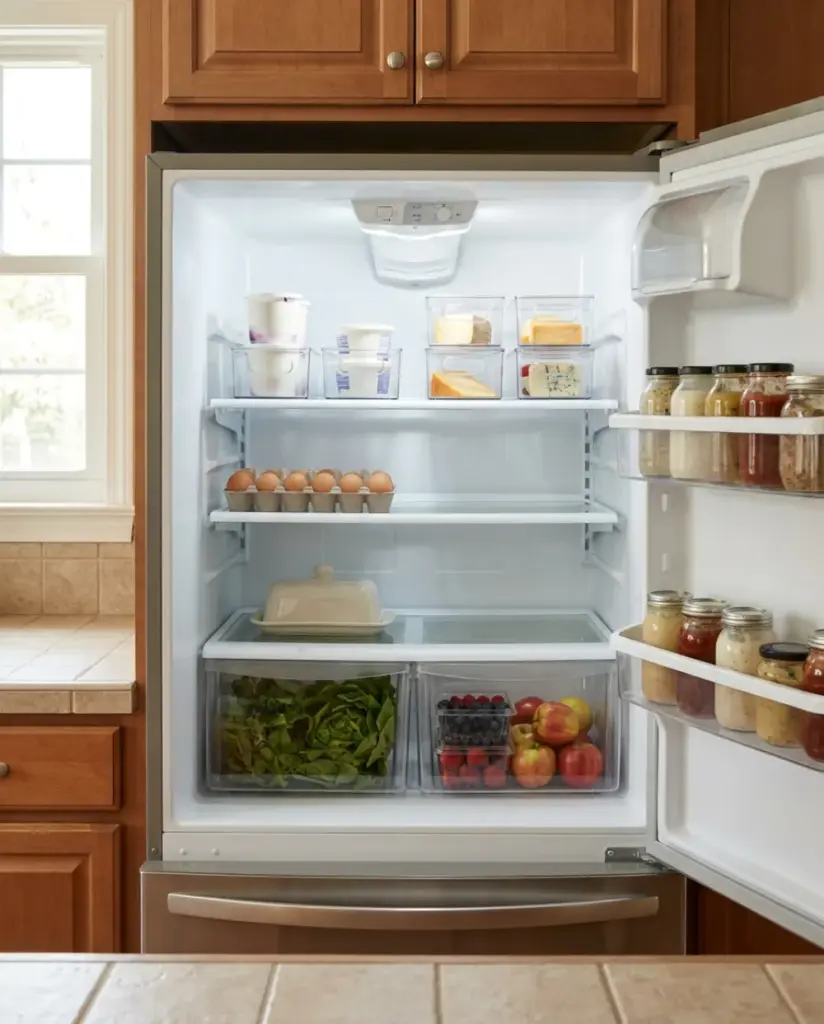
How to organize a fridge in 7 steps
To organize a fridge, empty it, clean it, toss expired food, and give every shelf, drawer, and door bin one job based on how cold it runs. Raw meat goes low, ready-to-eat food goes high, and condiments go in the door. These seven steps take most families one afternoon.
- Empty and clean the fridge.
- Check the fridge temperature.
- Toss expired and spoiled food.
- Assign each shelf and drawer a zone.
- Group like items in clear bins.
- Create an eat-first bin.
- Label, date, and leave room for air.
1. Empty and Clean the Fridge
Emptying and cleaning the fridge gives you a blank slate and shows exactly what you own. Move cold items to a cooler while you work so nothing warms up, and work one shelf at a time if the fridge is very full.
- Pull out shelves and drawers that remove easily.
- Wash them in warm, soapy water and dry them fully.
- Wipe walls, door gaskets, and the drip area.
2. Check the Fridge Temperature
Your fridge should hold 40°F or below, and the freezer should hold 0°F. FDA safe food handling guidance says to use an appliance thermometer to make sure the fridge is consistently 40°F or below. A cheap thermometer on the middle shelf tells you more than the dial setting.
- Set the freezer to 0°F or below.
- Recheck the fridge temperature the day after a big grocery run.
- Keep the fridge door closed during power outages.
3. Toss Expired and Spoiled Food
Tossing expired and spoiled food from the fridge clears shelf space and lowers food safety risk. Check every jar, container, and bag before it goes back in, and recycle empty bottles and jars as you go.
- Leftovers past their safe window.
- Produce that is slimy, moldy, or soft.
- Condiments past the date on the label.
The FDA’s refrigerator and freezer storage chart lists 3 to 4 days for cooked meat and meat dishes, which is a good rule for most leftovers.
4. Assign Each Shelf and Drawer a Zone
Assigning each shelf and drawer a zone works because every part of the fridge runs at a different temperature, so the layout should follow the cold. The EPA notes that the door is the warmest part of the fridge and the lower shelves are the coldest.
| Fridge zone | What goes there |
|---|---|
| Upper shelves | Leftovers, drinks, yogurt, ready-to-eat food |
| Middle shelves | Eggs in their carton, milk, cheese |
| Lower shelves | Raw meat, poultry, and fish on a tray |
| High-humidity drawer | Leafy greens, carrots, cucumbers, broccoli |
| Low-humidity drawer | Most fruits, mushrooms, peppers |
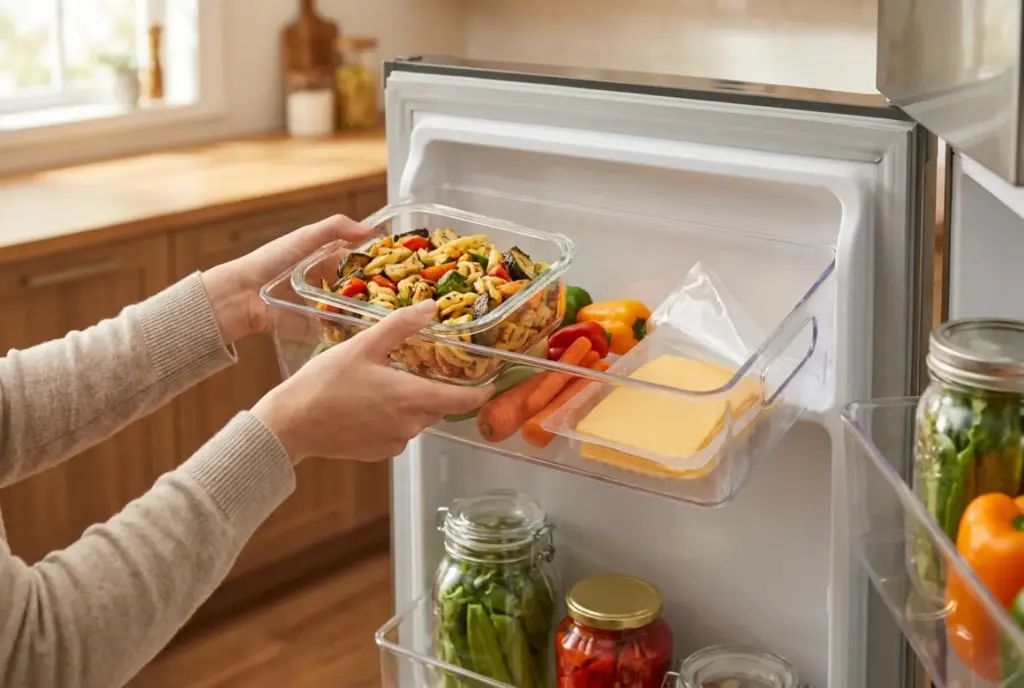
| Door bins | Condiments, dressings, pickles, juice |
Keeping raw meat low also keeps drips away from food that will not be cooked.
5. Group Like Items in Clear Bins
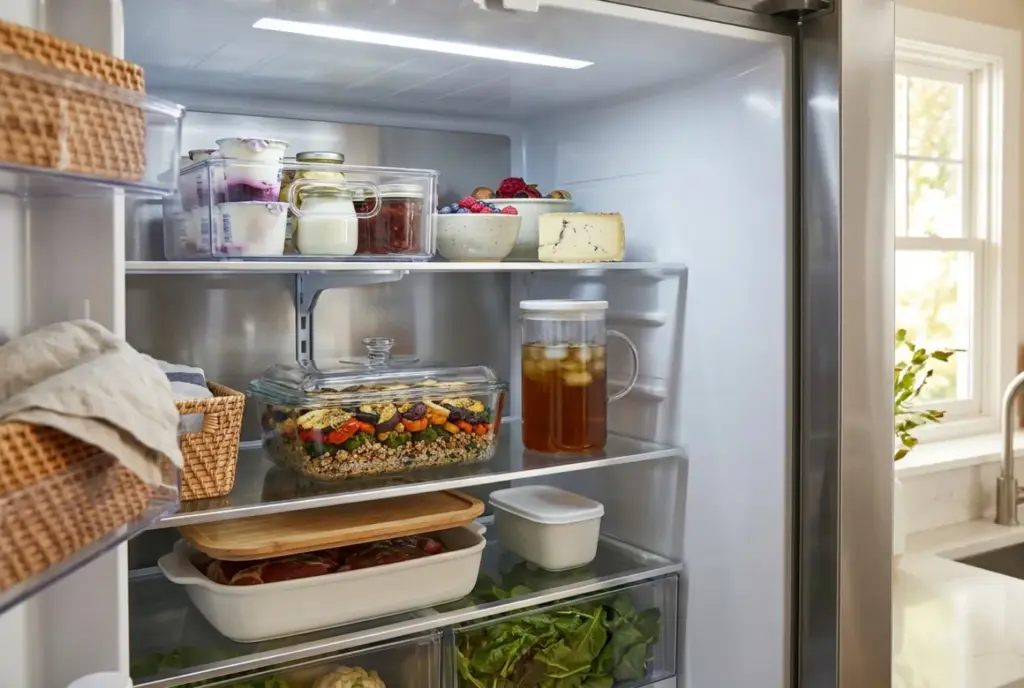
Grouping like items in clear bins keeps categories together and lets you pull a whole group out at once. Clear sides show what is running low. Measure shelf depth and height before buying, so bins slide in without blocking vents or the light.
- A snack bin for kids at their eye level.
- A breakfast bin with yogurt, butter, and jam.
- A tray under raw meat to catch drips.
- A turntable for jars on a deep shelf.
6. Create an Eat-First Bin
An eat-first bin holds food that needs to be used soon, so it gets eaten instead of forgotten. The same EPA food waste guidance reports that one-third of all food in the United States goes uneaten. Put the bin at eye level on the top shelf.
- Half-used produce and open packages.
- Leftovers from earlier in the week.
- Dairy close to its date.
7. Label, Date, and Leave Room for Air
Labeling and dating leftovers removes guesswork in the fridge, and leaving room for air lets cold air reach every item. The FDA advises against crowding the fridge so tightly that air cannot circulate.
- Write the date on masking tape for each leftover.
- Keep the back wall and vents clear.
- Store food in covered containers.
Should you put milk in the fridge door?
No, milk should not go in the fridge door, because the door is the warmest spot and its temperature swings each time you open it. Eggs belong inside the fridge too, in their original carton. Use the door for condiments, dressings, and sauces that handle small temperature changes.
- Milk: middle or upper shelf, toward the back.
- Eggs: middle shelf, in the carton.
- Butter and soft cheese: the door’s covered dairy bin.
What foods should not be kept in the fridge?
Foods that should not be kept in the fridge include potatoes, onions, garlic, winter squash, and eggplant, which keep better in a cool, dry, dark, well-ventilated spot than in the fridge. Ethylene-producing fruits, such as bananas, apples, pears, and avocados, should sit away from other produce, since they speed up ripening nearby.
- Store onions and potatoes apart from each other.
- Ripen avocados and stone fruit on the counter, then chill.
- Keep bread in a bread box or the freezer.
What should you always keep in your fridge?
A well-stocked fridge always holds a few staples that turn into quick meals: eggs, milk or a milk alternative, butter, cheese, yogurt, fresh vegetables, and a few sauces. Keeping staples in the same zone each week makes it easy to see when one runs out.
- Protein: eggs, cooked chicken, or tofu.
- Dairy: milk, butter, cheese, and yogurt.
- Produce: greens, carrots, and fruit.
- Flavor: mustard, salsa, and dressings.
How do you organize a side-by-side or French door fridge?
You organize a side-by-side or French door fridge with the same temperature zones, adjusted to the shape of the shelves. Narrow and wide fridges each need a slightly different plan.
Side-by-side fridge
Side-by-side shelves are narrow and deep, so use slim bins that pull out like drawers. Keep tall bottles in the door and everyday items in front.
French door fridge
French door fridges have wide shelves, so split each shelf into left and right zones. Put the eat-first bin in the center so it is the first thing you see.
Top-freezer fridge
Top-freezer models have shorter shelves, so stackable bins and a turntable make the most of the height.
How do you keep a fridge organized every week?
You keep a fridge organized with a five-minute reset before each grocery trip. Check the eat-first bin, toss what has turned, and wipe any spills.
- Plan meals around what is already open.
- Put new groceries behind older ones.
- Return every bin to its zone.
A weekly reset is the same habit that keeps a whole home in order, as our guide on clearing out a home step by step explains.
How does fridge organization fit into a whole-kitchen system?
Fridge organization works best as one part of a whole-kitchen system that also covers the pantry, cabinets, and counters. When every zone follows the same logic, groceries put themselves away faster.
- Our pantry organizing guide uses the same eat-first and zone ideas.
- Our guide to organizing kitchen cabinets and drawers follows the same rule of storing items where you use them.
- Our kitchen organizing services set up fridge, pantry, and cabinets in one plan.
We work with families from Alton to Edwardsville, IL, and we research bins and send shopping links you buy yourself.
Frequently asked questions
What is the best way to arrange a fridge?
The best way to arrange a fridge is by temperature: ready-to-eat food on upper shelves, raw meat on the bottom shelf, produce in the crisper drawers, and condiments in the door. That layout keeps food safer and easier to find.
What should go on the bottom shelf of the fridge?
Raw meat, poultry, and fish should go on the bottom shelf of the fridge, on a tray or in a bin. The bottom shelf is the coldest, and keeping raw meat low stops drips from reaching ready-to-eat food.
How do you organize condiments in the fridge?
Organize condiments in the fridge door bins, grouped by type, with a turntable on a shelf for extra jars. Check dates when you restock and toss anything past its label date.
Should you use bins in the fridge?
Yes, bins help in the fridge when they are clear and sized to your shelves. They group categories, catch spills, and let you pull a whole category out at once.
Want help organizing your whole kitchen?
If the fridge is only one piece of a kitchen that never stays put together, our team can set up the fridge, pantry, and cabinets with you in one plan. Packages start at $850, and you can request a free organizing consultation by phone.
Articles are researched and drafted with AI-assisted tools, illustrated with AI-generated images, and reviewed by Kalli Erwin before publishing.